“I am an independent white male!” declares Lord Catapult, Juliet’s father.
“NO ONE UNDERSTANDS ME!” yelps Romeo.
“I hate plays! Someone should write a play about me. TYBALT! It will be a musical, and I’ll play all the parts. I can be angry — and enraged!” yells Tybalt.
“I know 17 gay people. I counted,” says Paris, a Paris Hilton-like figure.
An two twelve-year old boys playing Romeo and Juliet. Having elected to do it.
Yeah, this project will be different from pretty much anything that’s out there.
Alt Ed Austin invited me to write a bit about the process that is making this very different RJ a reality. Read it here
Out of Ink, which included my ten-minute play Small Steps closed last night. This is my second time doing it, and I continue to be impressed with the organization. The ten-minute play festival starts with a bake-off in November, where playwrights scribble short things over a weekend. A handful are selected for production, and months later, we’re developing the pieces in rehearsal. And then it’s up for two weeks.
Small Steps opens with Skip Powers saying, “When I realized no one would ever love me, I volunteered to go to Mars. And those fuckers said, ‘Yes!'”
And that, essentially, is what the play is about. I’m working on expanding it to a full length.
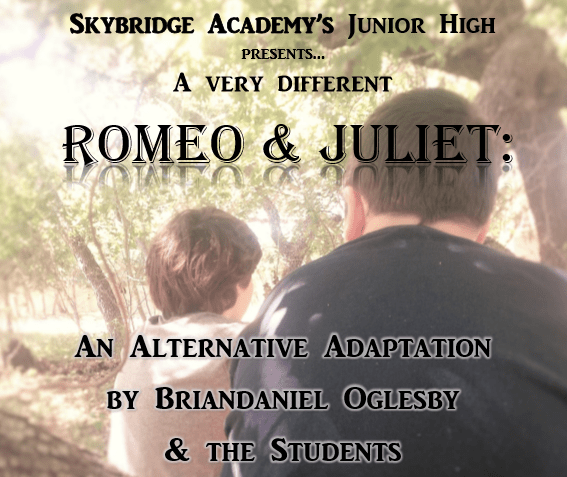
Or rather, I will soon return to working on it. I’m in the heavy part of my project bringing the junior high / LGBT version of Romeo and Juliet to Skybridge Academy into life. Most of the words are mine or the students’ — we stole fewer than you’d think from The Bard, but it’s still a hefty play for middle school students.
I have an article or two coming out soon that I’ll be sharing. Meditations on the process, you know, which has been quite special. I marvel at the fact that we’re not only doing a gay version of Romeo and Juliet with junior high students, but that the students made the choice to do this themselves. In some ways, this show will be like any other junior high show — kids will forget their lines and my blocking isn’t professional or anything — but in other ways, this will be unlike anything else out there.
This week, Emily Henderson of Acme Theatre is in town. We’re working with UT’s Drama and Theatre for Youth and Communities Program on a workshop for THE TWELVE HUNTSMEN (working title), culminating on Saturday. Some of my Skybridge students are involved.
Romeo and Juliet: Young and Star-Crossed is progressing. We’re all blocked. Most of them are off-book.
In the last few months, I’ve neglected this website as I’ve been playmaking and writing. My tires need to be rotated and I need to find a new owner for the dilapidated Taurus gathering leaves in the side yard, but I’ve written six full length plays and half a dozen short things since graduating less than two years ago. Choices.
Having finished the draft of my current project, I can work on back burner projects, though, so here’s the update.
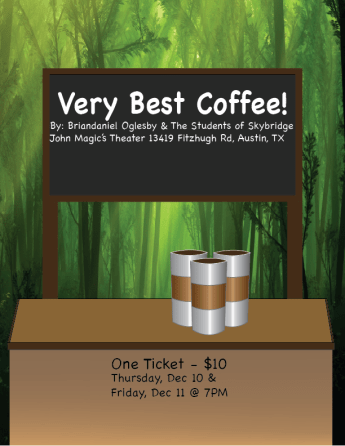
In December, my energy turned to the productions at Skybridge. First up was the high school’s production of Very Best Coffee, which lives in the kind of world where Women go to Crying Practice and the Men go to Football Rehearsal. Embedded in this play is a lesbian romance. At Skybridge, this doesn’t raise a single eyebrow.
A shot of tech week:
Tech WeekDesign by student, Andy R-M
The play is for high school actors, but the audience consists of adults. That possibility, perhaps, is what distinguishes Theatre for Teens from Theatre for Young Audiences. TYA assumes that the audience is (primarily) young people, and thus serves to reflect their world; Theatre for Teens lives in the liminal space between childhood and adulthood, and can encounter more mature issues, and it can criticize adultworld.
Something to ponder.
I’ll create a project page in the next couple of weeks with more details on Very Best Coffee.
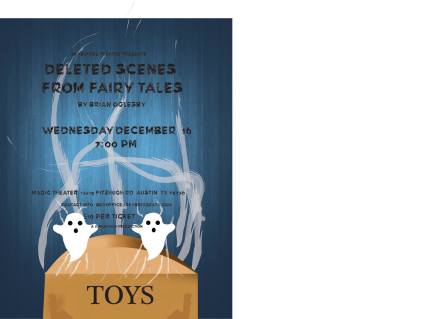
I also put up the junior high play, Deleted Scenes from Fairy Tales, which was a glorious disaster. A couple of the kids didn’t memorize their lines adequately, and the result was a mess of improvisation… but the play could handle these kinds of problems. When the students forgot a whole scene, I yelled from the back of the audience, “I WANT THE EVIL FAIRY SCENE!” and the parents didn’t realize that wasn’t part of the script.
Design by student, Nick L
Next Up
My collaborator and I decided to shelve the ISIS play for now, mainly because our timeline for working together fits another project. This project is titled Small Steps. It’s a full-length play in which a young man, tired of internet dating, goes to Mars. A shorter version is going to be part of ScriptWorks’ Out of Ink Fest.
In April, I’ll be doing an intense developmental workshop on The 12 Huntsmen, the play Acme Theatre of Davis commissioned me to write last summer. We’re partnering with UT’s Drama and Theatre for Youth and Communities program for this.
Finally, the massive project I just finished writing is an adaptation of Romeo and Juliet, with a gay romance at its center. A queer adaptation of R&J is hardly revolutionary, I know. Every time I mention it, I’m given yet another title of a gay version, so, in case you’re wondering, yes, I’ve seen bare. What’s actually important is that this is for my middle school students.
My Romeo is an eleven-year-old boy; Juliet is a twelve-year-old boy. We’re not doing Original Practices with a boy in a dress representing heterosexuality. We are doing this in Texas, a place where a couple years ago, a number of schools kicked out a play about gay penguins (portrayed by adults).
What a brave new world.
Romeo and Juliet makes sense as an LGBTYA play. Their love is taboo, and it precipitates a running away situation and suicide, which both engage contemporary problems. (And this opens up a Pandora’s box of other issues, that I’ll explore in future posts as well.)
What makes me feel alive as an artist is the prospect of working in that space of the uncomfortable. That’s where something real happens. This is where we grow, where it’s more about art than craft. And the people you are working with and how you are working can become part of the art itself, as important as the words and performance.
And it makes me uncomfortable. And it may make the Cruz supporters of Dripping Springs uncomfortable as well…
Lately, I’ve been herding the squirrels of my middle school students into performing a play and the battalion of my high schoolers into performing a different play, both of which I penned early in the semester for them. The result has been a lack of writing time. Or sleep.
(I’m updating this now only because I set aside this night to see a magic show that was cancelled.)
The texts will live outside of Skybridge, and they will carry with them both artistic and specific pedagogical intents. The arc of one character — Charles — lands where it does partly because I wanted to challenge the actor to be intense and emotional. To make him a better actor. This also serves the plot of the play, as well as what I want the audience to take from it, yes, so it’s not going to seem like a strange appendix or mutated limb.
I wonder what hidden agendas appear in the plays we think we know best?
***
The ISIS Play
Earlier this year, my (now) roommate and friend Caleb Britton approached me with this, “I’ve been thinking about these kids who run away to join ISIS.”
And now we’re starting to write a play about the people — a person — someone leaves behind when he runs off to join, well, ISIS.
I have nothing smart to say right now. Nothing profound. Just a simple moment to report.
In which he goes from cynic and skeptic to a believer…
Writing hurts. I do love it, I swear, but every choice of word feels like a problem I create, a thousand, no, a hundred-thousand piece puzzle entirely in shades of blue – and sometimes, more often than not, it’s the last thing I want to do.
But I do love it.
I enjoy reading the things that I wrote, at least the things that I cut and re-cut and re-re-cut and sanded down. I like to run my fingers over edges that may not be perfect, but are certainly smooth. So I do it.
This weekend was 14/48, a play festival wherein writers write plays overnight, and actors and directors bring them to life for two performances in the evening. This is a fairly common model, but the novelty of 14/48 is that it’s done a second night and day in a row.
(This weekend was also the Texas Book Festival, which I managed to visit and support some friends.)
I’d never done this thing before. Honestly, I hated the idea. I quietly believed that the benefits are in networking, creating community, and fundraising – certainly important things – but not art.
The reason that I gave was because I’d been to many-a-short-play-festival, but had seen few decent things emerge from them. And I think there’s merit to this – in such a small amount of time, devising often works better than playwriting. But the secret reason is because I felt like this kind of festival, should I participate, would reveal me to be the fraud of a writer that I secretly think I am. It would be revealed that I am a circus act, with a few rehearsed tricks, not a gymnast.
There are tricks, of course, which I could figure out even without doing it. Line memorization is a major hurdle, so avoid monologues, make each line of dialogue trigger the next, streamline the internal logic of the piece, establish early what the hell is going on, and make it make sense. And yet, knowing these tricks didn’t help me plunge into the icy water.
But
Then
I wrote two plays that I loved, drawing on a mixture of the previously mentioned tricks and my own bullshit. I got to work with amazing actors and one of my closest friends and collaborators. And I was with around fifty other people making shit for the sheer fun and adventure of making shit. And I made art. Other playwrights made art.
Sometimes, you need the music stands. Sometimes you don’t.
New play development takes many forms. Usually, there’s a reading with music stands along the way.
“Let’s hear the play.”
And I don’t disagree with this. As a playwright, a music-stand reading is easy to produce and to understand. Things are less likely to go wrong. You’re focused on the dialogue, the characters, the moment-by-moment vision. You can hear the whole of the story at once. You don’t have to worry about the theatricality — there isn’t any expectation that what you see is the final vision of the play.
About two weeks ago, I saw a play reading that avoided music stands. While we got the visual experience of the play’s action, the actors couldn’t walk and read at the rate that they later stated that the play needed. Audience members got bored and blamed the playwright, which they voiced in the talkback, and the actors blamed themselves.
(I’ll discuss the audience talkback at a later date.)
Now, I don’t know if the actors just jumped on the hand grenade, but that’s not the point. The point is simple: sometimes you need the music stands.
But sometimes you don’t.
Figuring out which is which is a helluva thing.
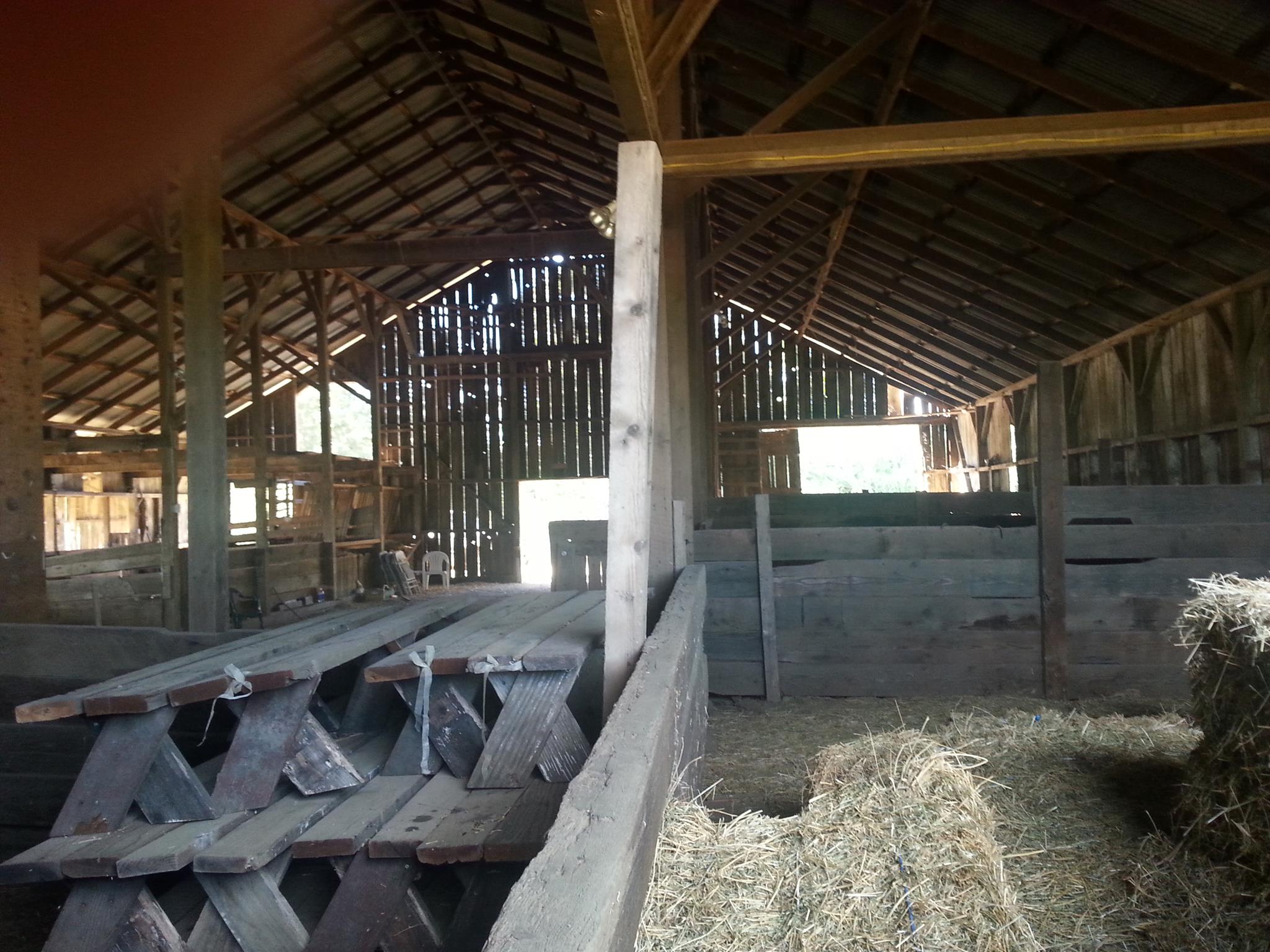
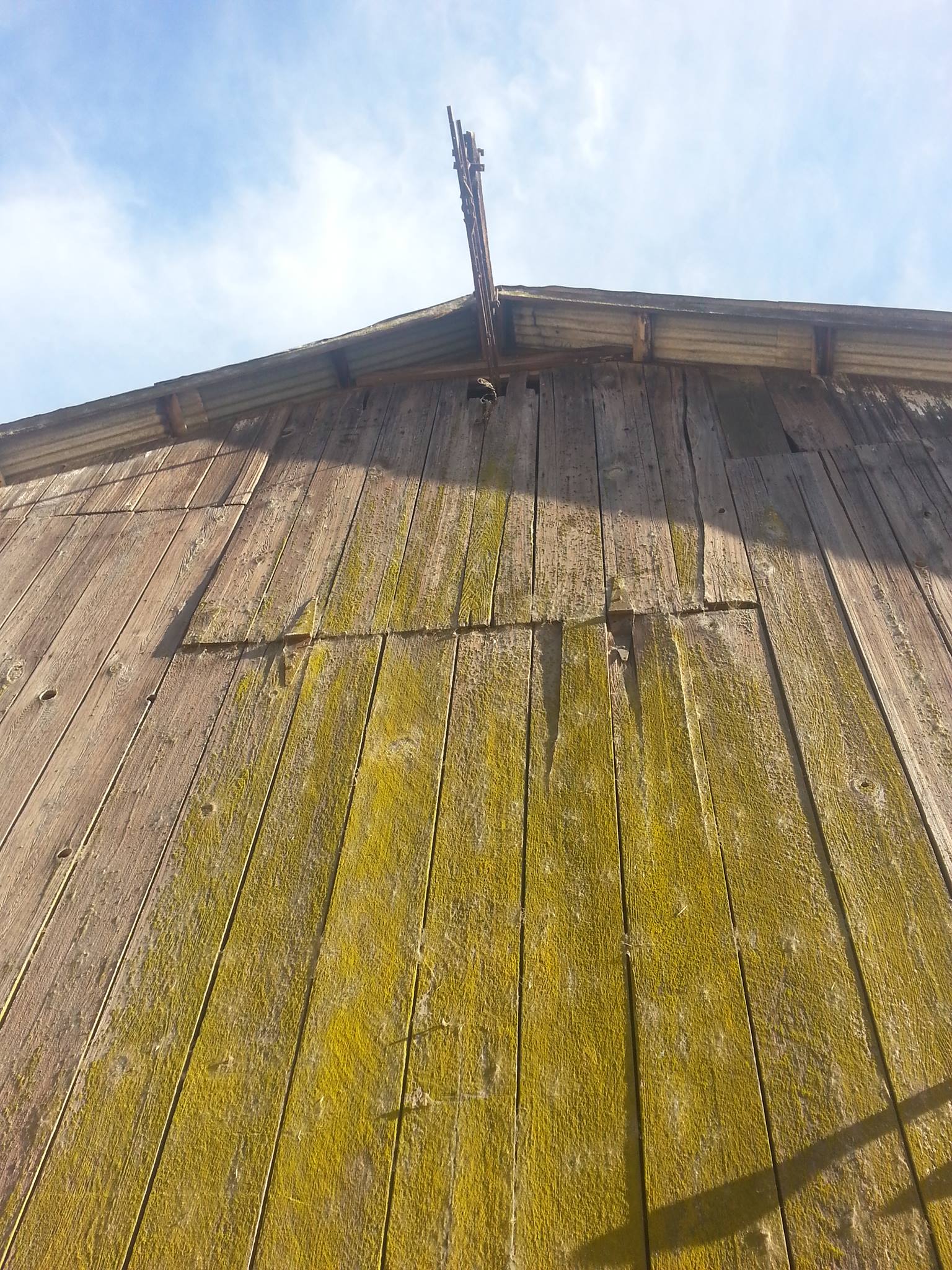
The One in the Barn: Nameless in the Desert
This summer, my new play development work included two ‘readings.’
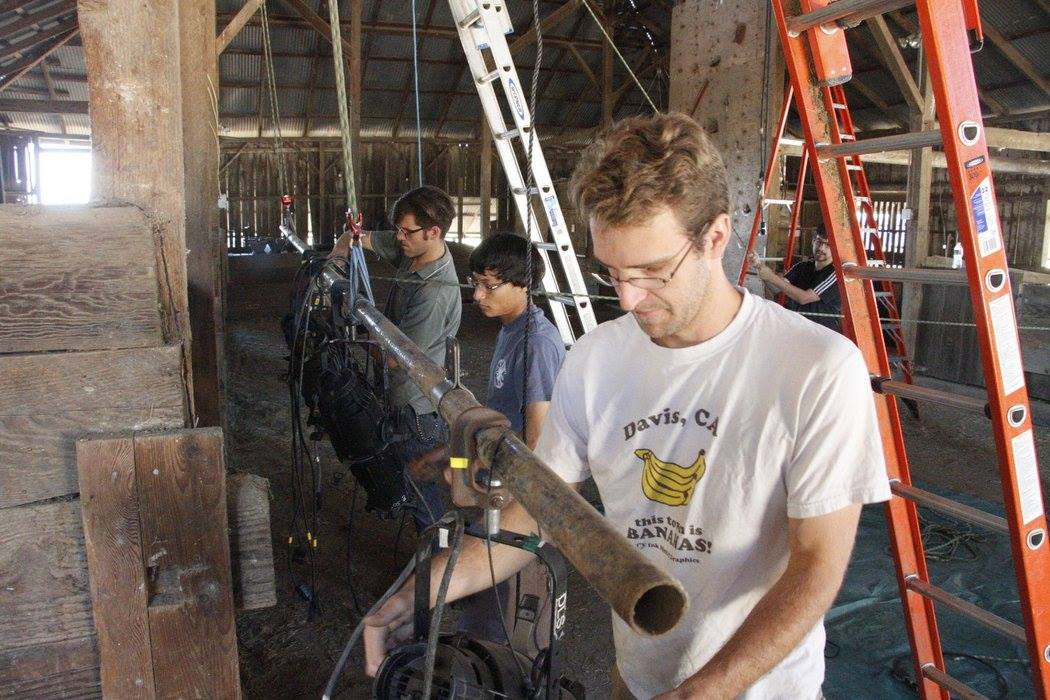
Over a week and a half, a team of awesome Imagineers (our tech crew, led by Betsy Raymond) teched the barn, built props, collected and created costumes, and generally lent a degree of badassery to our process. Meanwhile, under the direction of Emily Henderson and Heidi Voelker, a group of actors gave body and voice to the world of Nameless in the Desert while I added to the script.
Barnyard Theatre means we hang battons and the lights.
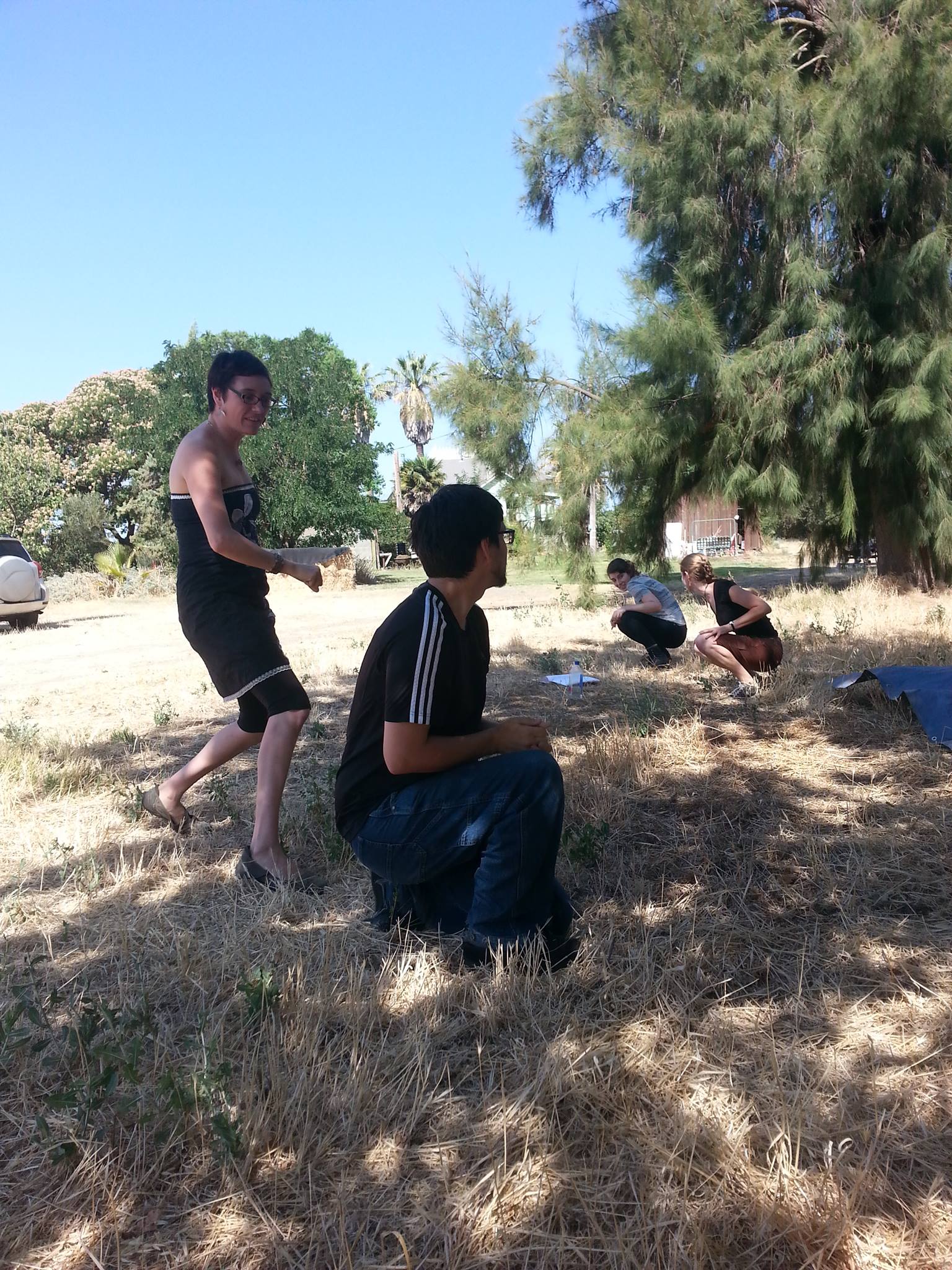
The script building process involved kinesthetic dramaturgy and improv-based activities, a devising process that sounds more revolutionary and modern than it actually is.
(In the larger history of theatre, single-author plays are less singular in their authorship than we like to think. Shakespeare wasn’t a solitary figure, scribing playthings like Emily Dickinson — he worked with a group of folks he knew.)
And the result was, essentially, the production of a play in which the actors had scripts in hand.
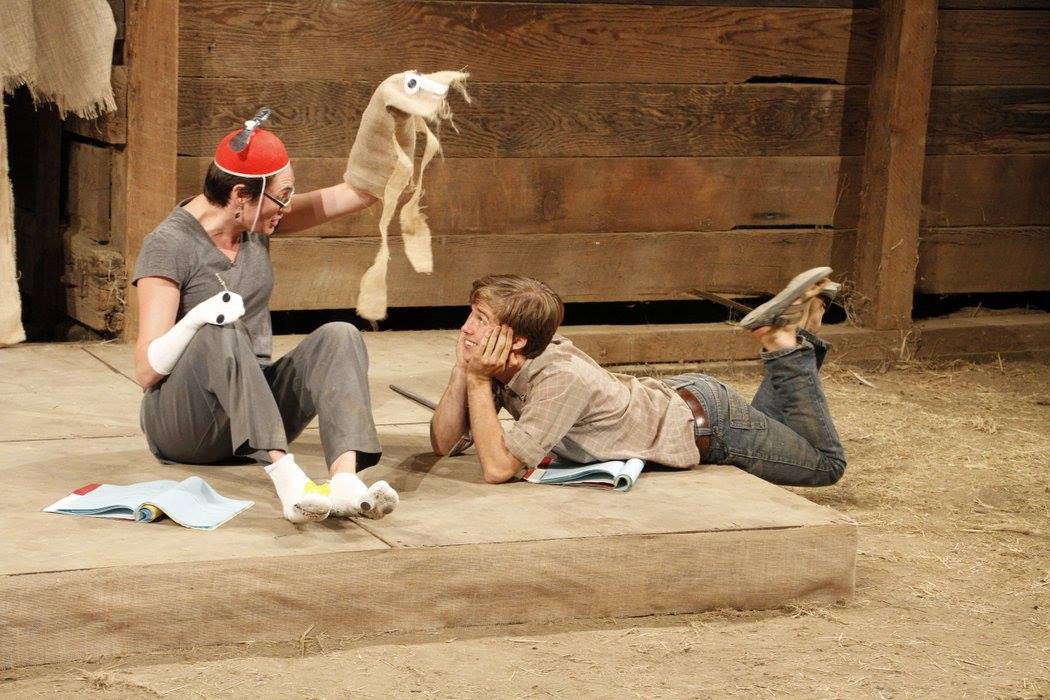
Jena Templeton and Matt Fyhrie as Actor and Nameless
I’ll take a detour to say this: I was blessed with phenomenal actors who were a) game to play, b) fully committed, and c) eager for the challenge of making the best damn play they could make.
We decided that what we wanted was for the play to be on its feet — to live healthily in as complete a world that we could make in a week and half. Thanks to these people — uniformly amazing — we could make this a world.
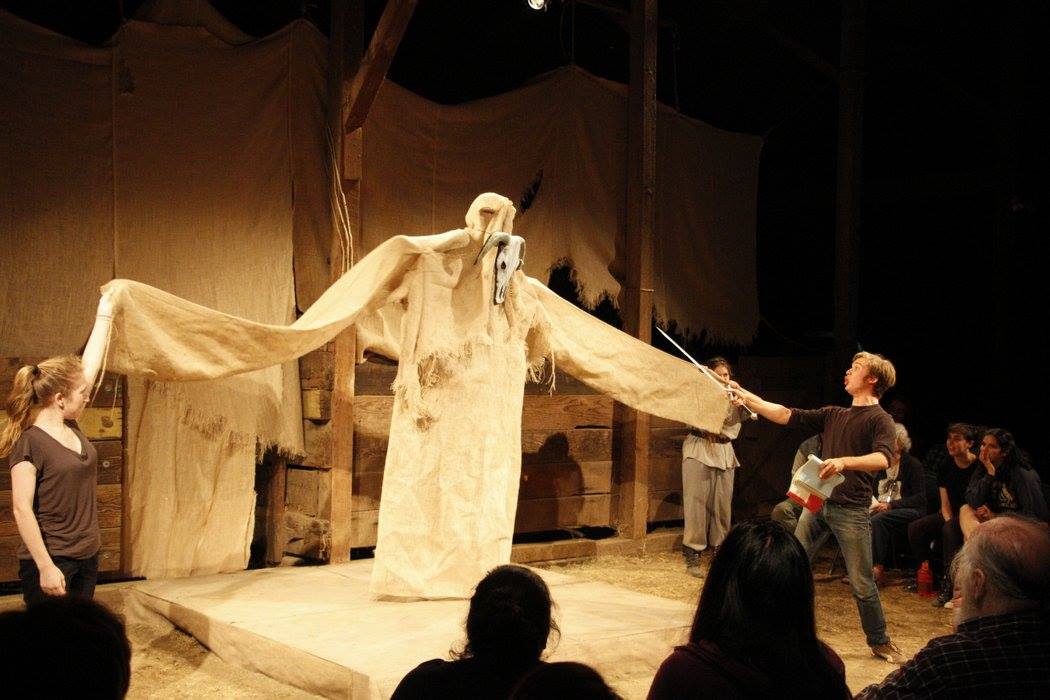
Nameless (Matt Fyhrie) battle the Sandman (Tim Smith and Tati Ray)Milli George and Leah JulianIt’s a biplane made of people
But it’s also a kinetic play, one that lives in motion — in sword fights and hijinks and visual moments for actors. Music stands don’t cut it, and the energy from blocking things far outweighed challenges such as pacing.
The One With the Teens: Fairy Tales and Feast
In a handful of weeks, with Acme Theatre, I wrote a play (with a title I’m still negotiating). I described this earlier.
This one held a different kind of miraculous reading at its end.
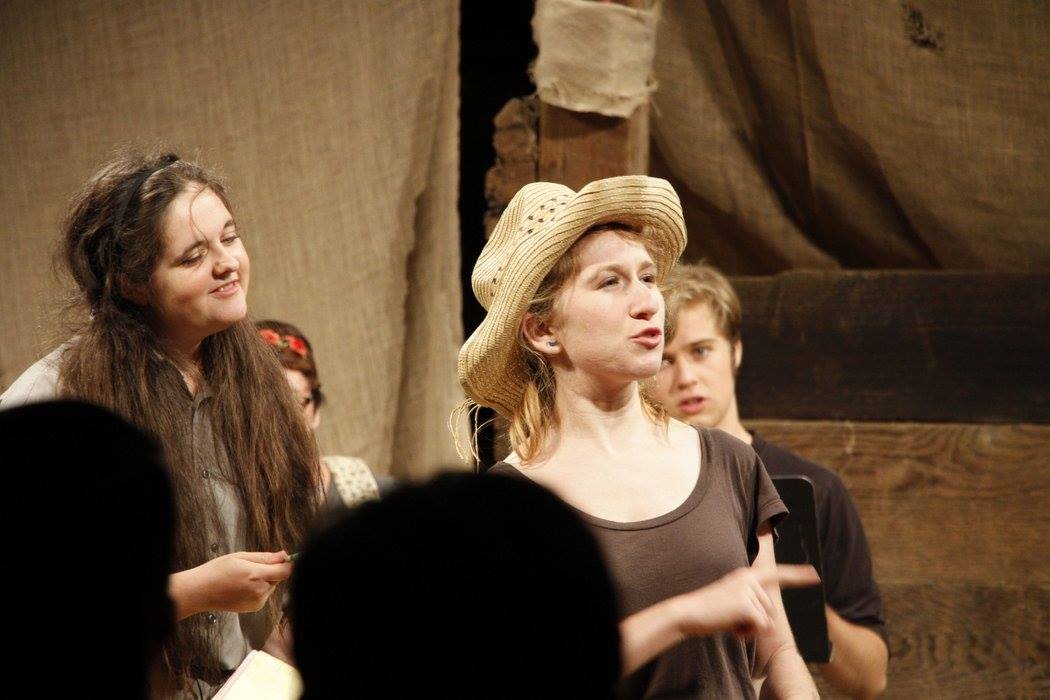
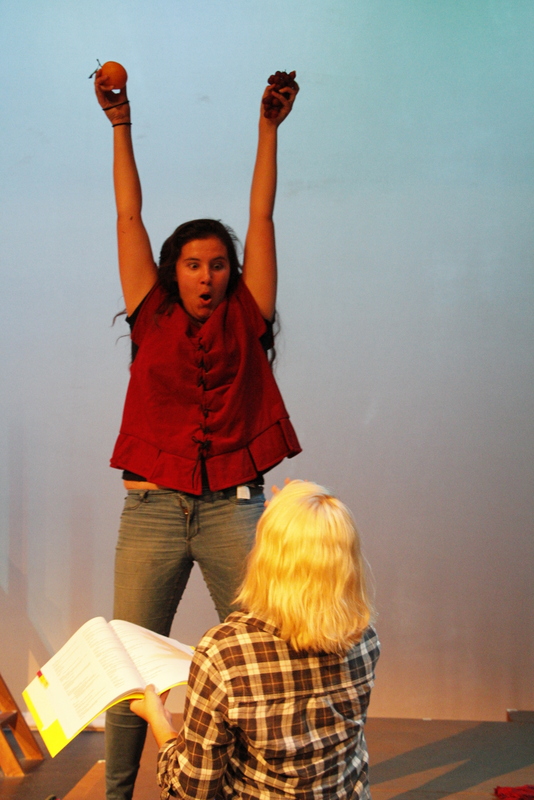
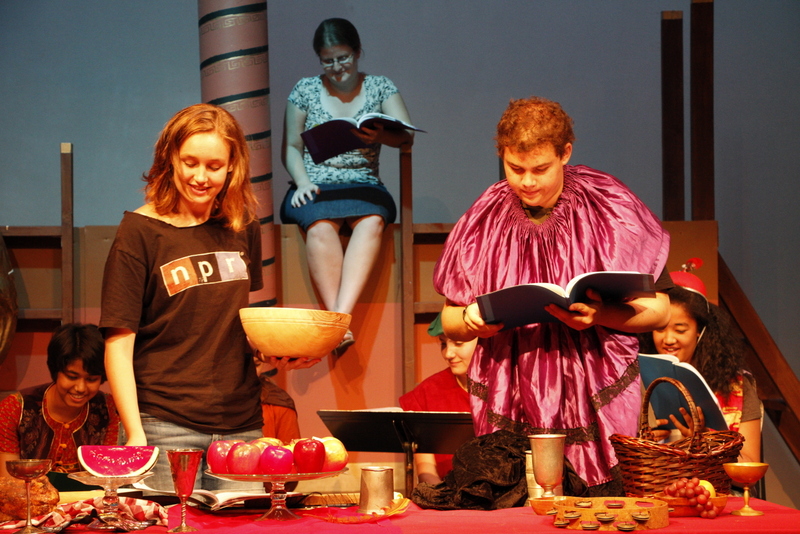
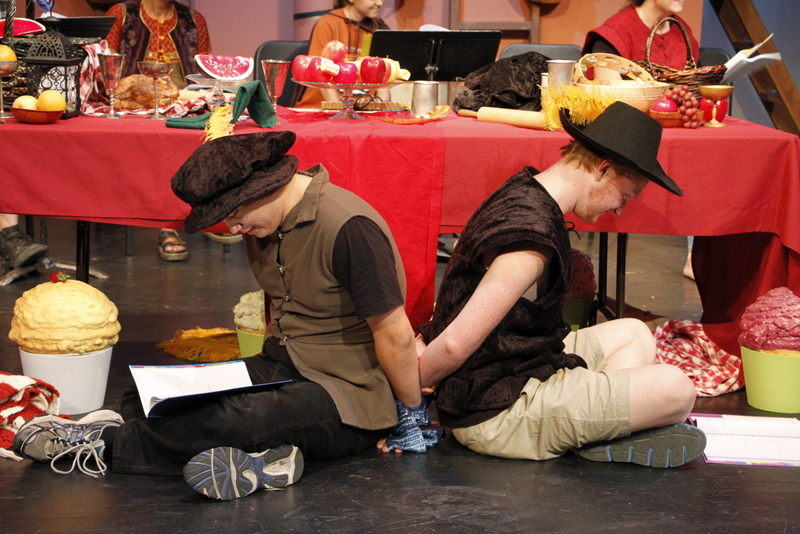
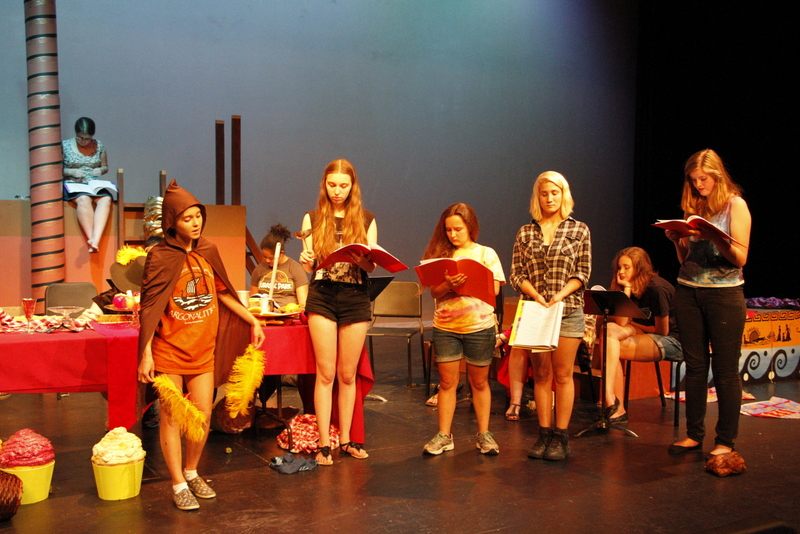
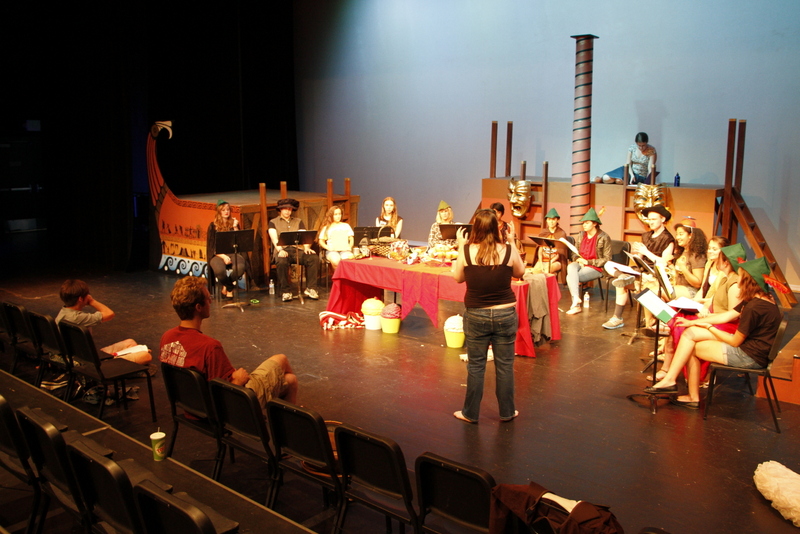
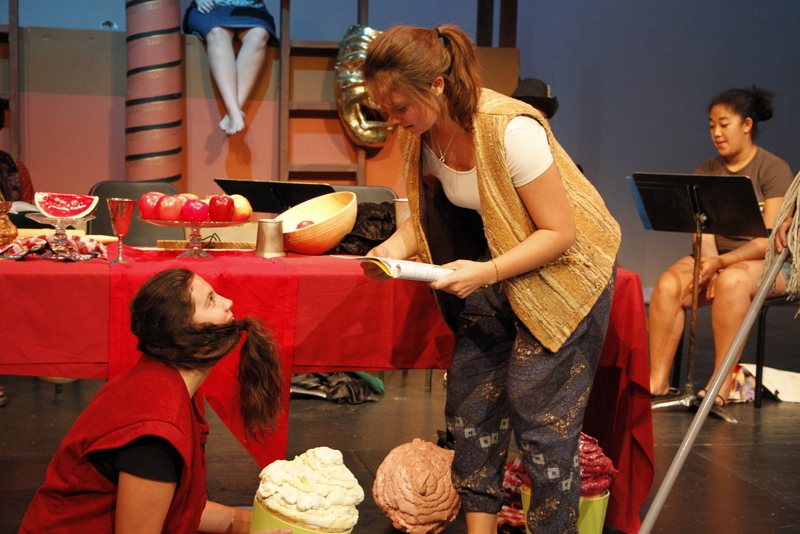
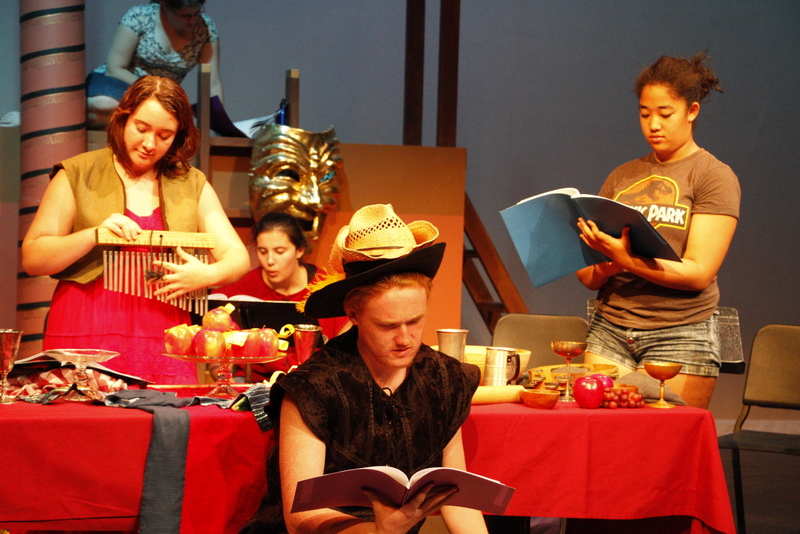
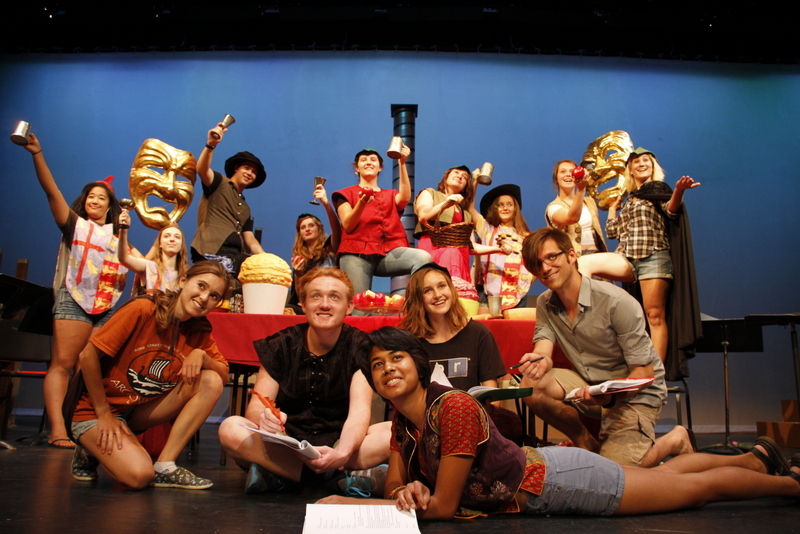
These pictures are from what, for most of them, was a cold read.
Photo by Robert SchulzPhoto by Robert SchulzPhoto by Robert SchulzPhoto by Robert SchulzPhoto by Robert SchulzPhoto by Robert SchulzPhoto by Robert SchulzPhoto by Robert SchulzPhoto by Robert SchulzPhoto by Robert Schulz
Sure, we started with music stands, but as soon as the Acmeites had the invitation, they were on their feet.
Emily, who also directed this play, explained this to me: “I don’t know. I just put out the costume pieces and the props, and they just do it.”
These teens instantly created the world of the play, acting it out fully.
This one was playing a goat.
This isn’t supposed to happen. You’re not supposed to simply give teenagers a script and some costume pieces and then sit back and watch as they fully create a play.
Including adding occasional sound effects.
LIFE IS NOT SUPPOSED TO BE LIKE GLEE!!!
But it happened. And it blew my mind. It changed what I believe is possible for New Play Development. It made me ask, what happens when you just DO the play. Certainly, sometimes it’s a disaster, or at least not nearly as useful as the aforementioned reading demonstrated — but could that be partly because actors are trying to remember their blocking AND their motivations? And when some folks are doing a cold read, you’re focused on getting up and moving instead of remembering your blocking and the directions?
Photo by Robert Schulz
Could it be that this play just happens to lend itself to this kind of energy?
I don’t know, but I’m interested in finding out more.
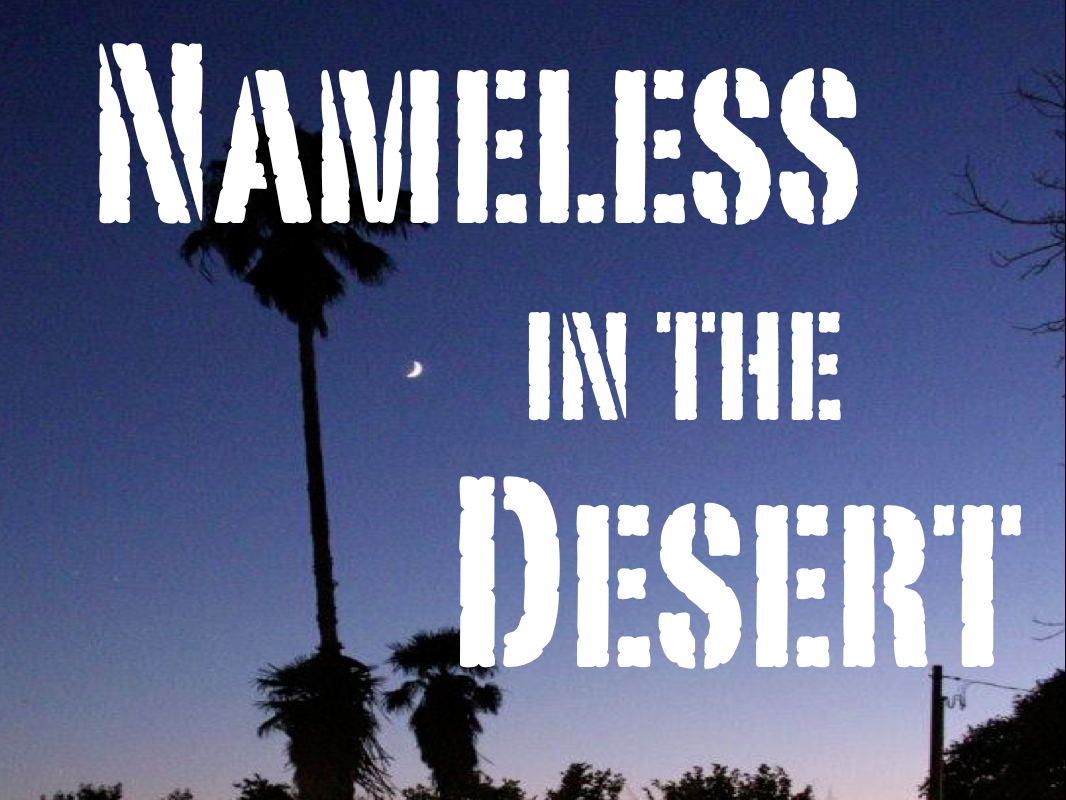
Nameless in the Desert
Written by Briandaniel Oglesby
A performed reading directed by Emily Henderson
Nameless awakens in the desert. He doesn’t know who he is. He doesn’t know where he’s from. All he knows is that he has a sword and a desire to be great. And so he sets off on a journey that will take him from sand monsters to the tyrant king. Will he find greatness or will he find himself? He can only choose one. The performed reading of this new comedy for All-Audiences will culminate a week-long developmental process with actors and a team of Barnyard Theatre tech folks.
Little Red and the and the Quest with Many Sons – a Choose-Your-Own-Adventure Story
Written by Lindsay Carpenter
Production directed by Maddie Stone
Little Red’s father has been kidnapped by a dragon, so obviously she goes on a quest for him. In this fractured fairy tale with many sons, tests, and transformations, the audience will have a number of points where they will decide what Little Red does next.
Performances:
One Night Only – Saturday July 25 at 7:00 p.m. or 10:00 p.m.
(But, hey, at least there are two performances!)
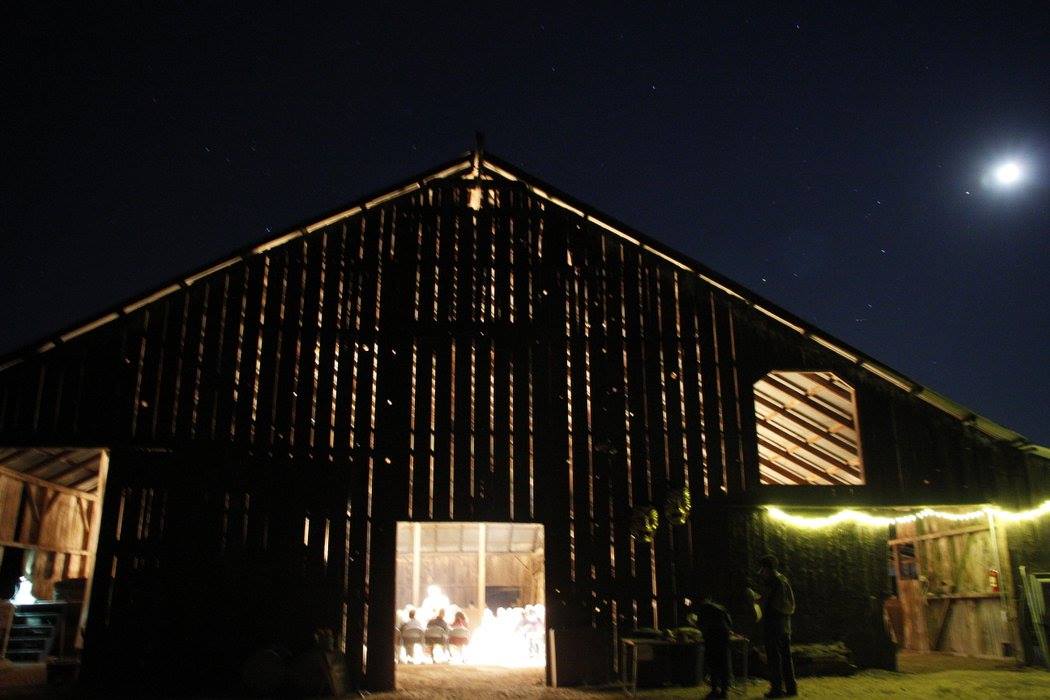
at the Historic Schmeiser Barn, 35125 County Road 31, Davis.
Each performance will include both plays.













 Briandaniel Oglesby