New Play: Dead Victorian Child

A comedy.

The Pitch: A pair of bickering spiritualist sisters, a patent medicine peddler selling literal snake oil, a fairy whisperer, and a time traveling inventor with his mechanical monkey all come knocking on the Briar family’s door when a child appears to have died after reading books that were too much for his delicate Victorian sensibilities. They claim they can contact the dead. Their grifts (and pasts) are exposed when the child “returns” to life.

The child has a story to tell – and Barnum and Bailey are eager to profit from it.

This play starts as a farce, though the satire transforms into a different kind of imaginative comedy complete with grave robbing, LGBTQ storylines, a seance that brings back an irritated mother, a time-traveling jaunt through the 20th Century, a fight with a dinosaur, assassins, a League of Non-binary Street Urchins, and more as the child invents the stories of the grifters. When he’s exposed as a fraud and Barnum and Bailey decide to literally bury him, he is forced to confront his own truths – and invent more hopeful endings for others.
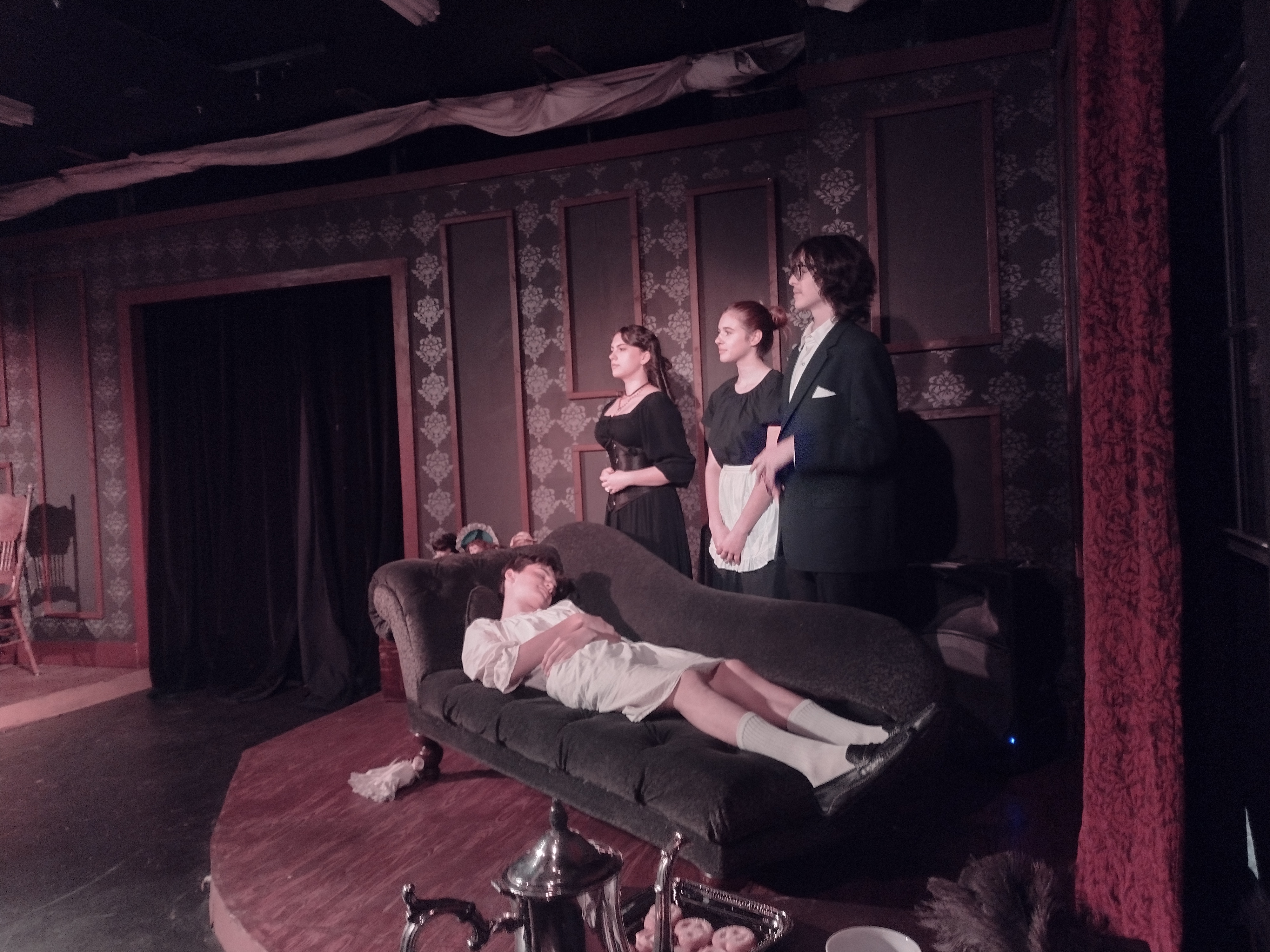
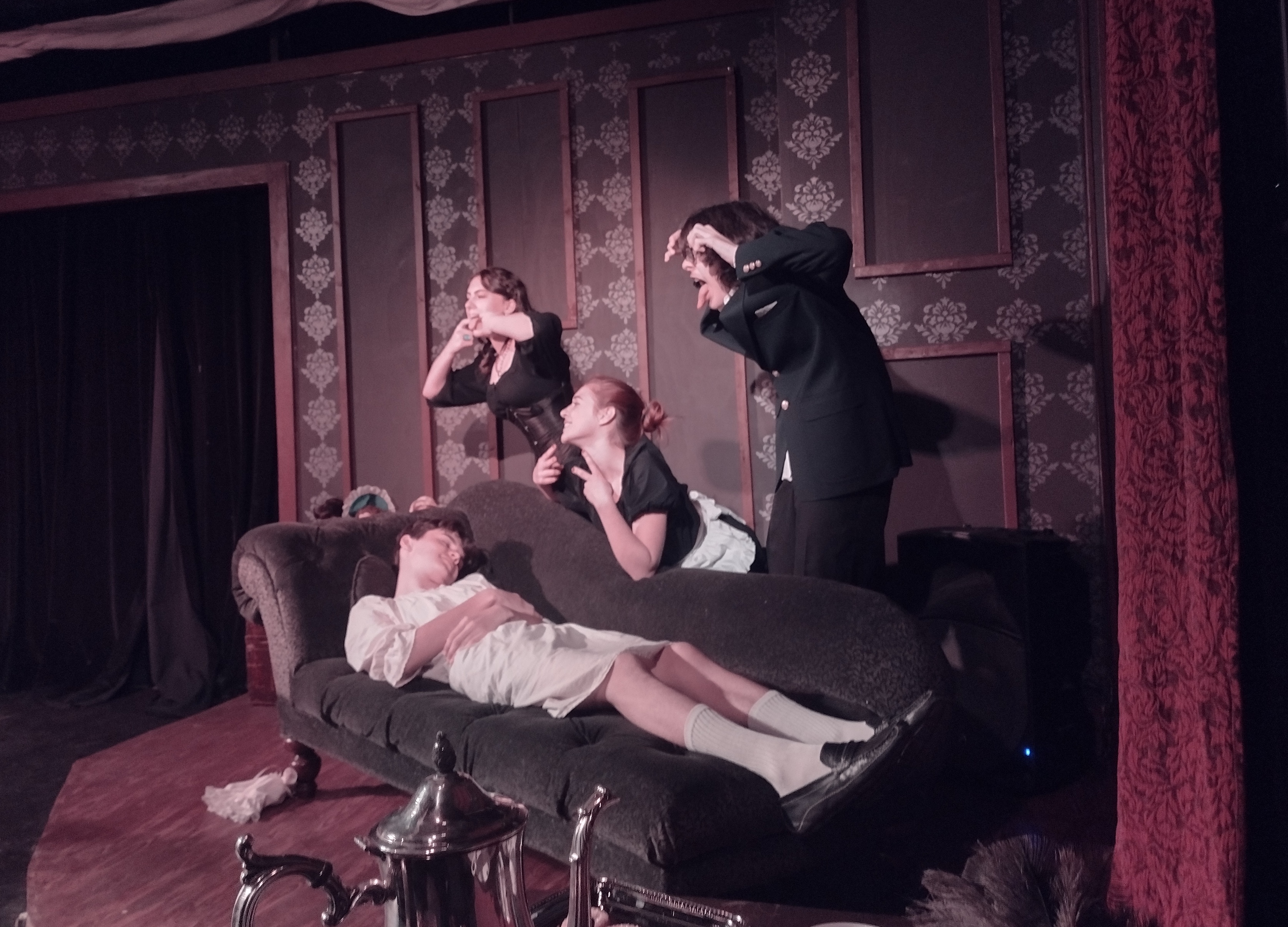
*

THE PROCESS

When I write a play with and for my students, we always come up with a handful of ideas that we have to put aside. The promise I make to the shelved plays is not, “You will never exist,” but instead, “I’ll see you later.”

The kernel of this play came last spring. Cavepaint was a greater technical challenge, and with a highly experienced set of technical students I wished to challenge beat out this idea, but a story that started with a child faking their death while a farcical slew of grifters tried to take advantage of the kid’s parents was a delightful option.

DVC is a way of taking everything that intrigues me about the Victorian era and distilling all of it into a single story. I am struck by the confluence of science and “magic,” enchanted by the aesthetic, and fascinated by the changing relationship to death. We are in an era of modern grift, of course, and I can’t help but to connect the TikTok Vitameatavegamin influencers to the patent medicine purveyors, so that may be why these folks have my interest, but I think it goes beyond that.

Before DVC, I would have happily just written a play about the Fox sisters, the Cottingley fairies, or Mumler’s spirit photography, or patent medicine men, or industrial inventors, or grave robbers. I happened to have a massive cast for this play, so I decided to fold ALL of them into the same story.

Act I is in one location, and it’s built to be a farce. The joke is that everyone is lying. Towards the end, we learn the lies, which these characters use to survive the oppressive Victorian era. We also see how the dead child’s lies start innocuously, and how the possibilities of profit can lead to greater lies (much like the Fox sisters, by the way).

And as we created the play, I was realized I could easily accidentally repeat the structure of Forever Christmastown. In FC, the belief in a fake miracle leads to a cult following, which leads to an actual cult and a theme park declaring itself a sovereign nation.

I realized that it would be far more fun to imagine that all of these liars were, in fact, telling the truth. The joke becomes the absurdity of their fictions. What if the Fox sisters could contact the dead – and they used that to get their dead mother to arbitrate sibling rivalry? What if a patent medicine could bring someone back from the dead (specifically, someone who’d been raised by a grave robber)? What if there were secret societies of doctors and assassins scheming to suppress miracles?

That all of this is told by the not-so-Dead Victorian Child, the liar who just wants to be liked, means that we can both tell the story as if it’s real without suggesting that modern grifters are, in fact, telling the truth.

In the process, some of the students requested that improv be incorporated into the play. Several scenes have moments that the actors are invited to create themselves.

At the end of the day, I wanted to make a play unlike anything you can find anywhere else.

Dead Victorian Child is up on the New Play Exchange.
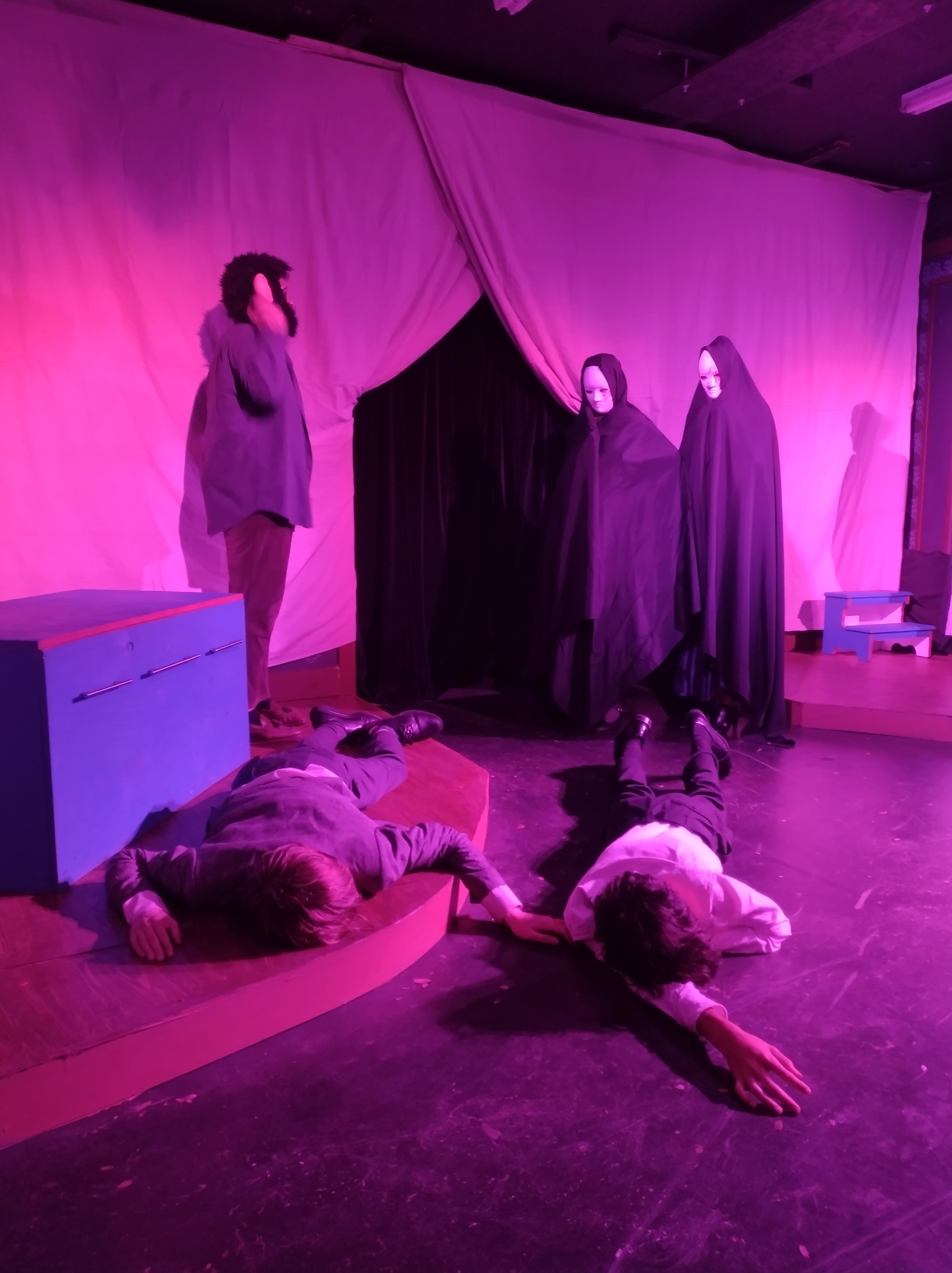
UPDATES: new Plays

UPDATE 1: The Apocalypse Project is licensed through Uproar Theatrics!

I’m delighted to announce that Uproar Theatrics has added The Apocalypse Project to their catalogue. They license high-quality plays for the high school (and older) market. This play is hugely important to me, so it’s an honor for it to have greater visibility.

UPDATE 2: NEW PLAY

Anne Bonny and Mary Read, Late of the Island of Providence, Spinsters and Enemies of All Nations, are Charged with Piracies, Robberies, and Felonies is now available.

THE STORY OF THE STORY:

Coming into the fall, after a year of farce and fun with The Odyssey and SINK! A Titanic Murder Mystert, I wanted to grapple with some hard stuff. I borrowed Acme Theatre Company‘s motto, “Serious Theatre… For the Fun of It,” and we set to work.

For those of you visiting this website for the first time, here’s my deal: I make a few plays for mature audiences and MANY plays for young actors. The work for young folks is written for and with an ensemble of students, who help create the world of the play. Devising is used, but the plays are solo-authored.

I want every play I write, especially those written for middle schoolers, to have the same rigor and artistic validity as a play you’d see in a professional space.

With “Serious Theatre… For the Fun of It” as a backbone, we spent a good couple weeks prepping the soil. We worked through numerous topics of varying intensity, and we talked about the difference between space of the uncomfortable (where growth and learning is possible) and spaces of panic (spaces that trip our flight-or-fight responses). I did a process where my ensemble members could anonymously remove subjects that were too intense for them.

We landed on Anne Bonny and Mary Read, two actual female pirates who’d often (at least according to some sources) dress as men during the Golden Age of Piracy. I had one student who’d already done research on them and another who was eager to swashbuckle, and a group of eager ensemble members delighted to get all piratey.

In the end, the result was a play I’m proud of, one that could as easily wind up swashbuckling the stages of a high school, community theatre, or large-cast oriented professional theatre. Pictures and pages coming soon.

UPDATE 3: Into the Cave (or In the Cave or The Cave or something like that) – COMING SOON!

It’s been some times since the last update because I’ve been scribbling away at the newest play. This one is for my middle schoolers, but I think that it will likely wind up resonating more with high schools.

Here’s the concept: A cave painter paints the stories of those who get lost in the cave throughout time.

We all get lost in our own lonely caves, after all. A cave of grief. A cave of guilt. A cave of self-doubt. A cave of creation. A cave of ambition.

My initial inspiration was Ray Bradbury’s The Illustrated Man, though that evolved because we didn’t want to make it a collection of short stories. The question became, what happens when these characters start to meet each other?

The cave is already metaphor, and so when I explain the concept with a metaphor I feel silly. And yet, here we go: you’re at a coffeeshop with a handful of tables. At each table sits someone going through something. At one table, there’s an artist listening in and sketching all their stories. And then something happens at the coffeeshop – an earthquake, a stranger comes in and acts weird, someone burst into song – and all of these strangers look up and they see each other.

I do most of my writing at cafes, and this is what it’s like. You’re in a lonely creative hell, and then something happens, and a conversation with a stranger starts, and for a moment, you’re no longer alone.

Remarkably, this play’s process has been the most I’ve been in sync with my teenage collaborators. This play started from a desire to challenge my theatre tech students, and yet it wasn’t driven by design. I’ve been teaching ten years, and this is my twentieth play as part of my job, and I wanted to do something different, and I’ve been fortunate to have a group of mostly middle schoolers who are on the same page. At every single creative juncture when I thought the kids would want to make the easier and fun play, the less-artsy-plot-driven-play, they challenged me to make the play that I secretly wanted them to force me to make. It’s a harder play to write, but more rewarding.

In fact, we cast the show early because the students had pretty much all picked their roles. There was, essentially, no overlap – each one got their first choice.

I’ll either write another post or article about this at a later date. In the meantime, I’ve taken the day off so I can have fresh eyes on it tomorrow. Maybe I’ll have picked my title.