The Trilogy is Over

Yesterday I put the finishing touches on Space Carl OR How to Get Lost on Planet Venus *no relation. Thus closes what accidentally became a trilogy.

In The Untitled Pirate Play, after a bad breakup, Carl sets off on a hero’s journey like young Jim Hawkins in Treasure Island. The ambition of the other characters is more than enough to propel the play, and Carl spends most of the story hiding or in the brig. When he finally tries to take a stand, other plot elements have come together at that moment to destroy the ship he’s on. The play is about ambition and the corruption of power, and in the end both the guilty and the innocent suffer the consequences. Carl is the only survivor.

There was something delicious about taking the form of the hero’s journey, positioning a character as a lead, and then having this character have no impact on the play.

In And Then, She Picks Up the Sword, Carl happens to be an attendant to the obnoxious Prince Driftwood who is supposed to marry Princess Wimberley. He spends most of the play having lost all his memories and thinking that he’s a dragon. He dies when his heart is used to make a potion, but he’s resurrected with a borrowed heart. He misses the climax of the play.

The process for creating this play was innovative – based on a student’s set design – but a major element was that this was my response to elements of Shakespeare rom coms that bother me – essentially, how the love stories happen. Initially Carl appeared as a wink to people who knew Pirate, but he ended up having his own transcendent moment at the end… and I knew he needed a story of his own.

I have a complicated relationship with the hero’s journey, both as a trope and a structure. Structurally, it centers the entire story on the actions of an individual, and the ‘right’ way for the story to end is through their choices. Luke blows up the Death Star; Odysseus defeats Penelope’s suitors. I question this for a number of reasons that I won’t get into. It’s also considered a ‘masculine’ form, and is usually centered on men. I wanted to make a play that both uses and subverts the hero’s journey genre. And the ending of Space Carl, I hope, does this – his body is ‘hosting’ an alien organism, he escapes the climax, the villains are defeated by poetry, and more.

Gender representation is an issue. I did worry that it would appear that I’d written three plays for male leads, but I also know that Carl’s impact is so negligible on Pirate Play and he’s such a side character in Sword that he’s not actually a lead in either. Part of the joy is that the audience may expect him to be the protagonist, but he’s not. Also, it doesn’t change either play to have him be a Carla.

In Space Carl  I knew that pretty much any part could be played by any gender, but I also knew that if you’re trying to subvert a masculine genre, when you make the lead a woman, the statement on the subverted structure becomes, “This is the GIRL version of a hero’s journey. It’s not a real hero’s journey.” For our production, I did end up casting a young woman, though she’ll play it as a guy for that reason.

The beautiful thing about making a play set in space is that gender explodes and the limitations that are usually placed on casting go out the window. On his journey, Carl stumbles on his ex, but his ex had an encounter with a body switcher, so ANYONE can play that part. The ex (named JJJJ) has a second ex, but this character has also switched bodies. As for the other aliens, what I realized was that, although most sci fi universe bifurcate genders into male and female, you could just as easily have a species with one or five or six hundred genders, which means that every part could be played by anyone.

Why is this important now? One of the first questions people making theatre with young people ask about a play is ‘how many boy  roles and how many girl roles?’  This question bothers me on many levels (not the least of which is that there are many trans and non-binary kids coming out at younger ages, and this question is insensitive to them). It gives me great joy to write a play where, should this be produced by others, that question becomes meaningless.

Anyway, there’s a new play in this world now, and I love it.
Update

A week ago, we were deciding between sending Carl to Atlantis and sending him to space. We improvised around research images from the tech classes, and I decided space was setting us up better for a hero’s journey.

This week was about building plots for story starters. This is usually where the students thrive, but I found that they were struggling to think about larger narratives. I tried structured improv activities and devising around images, and eventually we had a few narrative threads. Tomorrow, I’ll look over my notes and make some choices about where to go next.

***

Flexible Grey Theatre Company will be doing a reading of Small Steps in Dallas.

It will involve a drinking game.

***

I have a couple more productions of my middle school work coming up.

A New Year

Last year, I focused on writing, and I drafted four plays – Icarus, [More] Deleted Scenes, Piper, and And Then, She Picks Up the Sword. This doubles the output from the previous year.

Piper is the new title for Knitted.

I am about to kick off the third chapter in the adventures of Carl – previously seen in And Then, She Picks Up the Sword and The Untitled Pirate Play  . 

In Pirate, Carl stows away aboard a ship – and has very little impact on the plot. In Sword, he plays a secondary character, who loses his memory and misses the climax of the play by being dead for a little while. I love this. I can see the anger of a dozen playwriting workshops as they turn on me – a hero is supposed to impact the plot, of course, and I love nothing more than doing the opposite of what I’m supposed to do when I write. This semester, I’ll be using tropes from Joseph Campbell’s work as base material, and Carl will either be in space or in Atlantis.

The Process

I’m spending the first couple week focusing on skill building – specifically improv and story-building. My tech classes did some dramaturgical research on possible ‘worlds’ – space and Atlantis – and we’ll be using the images, sounds, and videos to devise and improvise next week.

New Plays

A week ago, we finished the semester with [More] Deleted Scenes from Fairy Tales with the middle school students, and Icarus Livingstone Falls Into the Sea with the high schoolers. I’ll be getting a page up for Deleted soon, and I’ll post a post-show draft of Icarus when I have time to digest and reflect.

In the meantime, some details:

IMG_9587
The Dwarven Miners Union protesting Snow White’s unfair labor practices


[More] Deleted Scenes from Fairy Tales

Script available on NPX

Storytelling creatures share assorted apocrypha of old stories.

Three Little Pigs: The Three Little Pigs are roommates in a band. After playing at Stubbs, the band breaks up. Being creatives, they build their houses out of straw, sticks, and bricks, but the winds of gentrification threaten to blow them down and turn them into breakfast tacos. “Little pig, little pig, let me come in.” “Look, man, my money was good when I wrote you the check. If the check bounced, that’s on you, not on me.”

The Boy Who Cried Wolf: The wolf is unemployed and seriously thinking about opening an Etsy store when he hears the boy calling him.

Snow White:  The dwarves are member of the United Dwarven Miners Union, Local 64, and when Snow White takes over the house they prove that the Union keeps them strong.

Rumplestiltskin: When the Queen is unable to guess his name, Rumplestiltskin actually gets a baby – and realizes he’s far from equipped to raise it.

Little Red Riding Hood:Little Red does not guess that her grandma is, in fact, the wolf…. And the wolf must then take on some of Grandma’s responsibilities.

Goldilocks and the Three Bears: The three bears vow vengeance and break into Goldilock’s house to destroy her stuff.


Icarus Livingstone Falls Into the Sea

The Dead put the broken Icarus back together, assembling his story into a labyrinth. They tell of his boyhood friendship with Tor, who would later become The Minotaur, and Theseus, the hero who would kill Tor.  They tell of his ambitious and distant father – who enabled the cruelest of the king’s actions. They tell of the mothers who miss their boys. They tell a story of how the boy fell from the sky — 

48240821_10157946976683332_9163555559171948544_n

← Back

Thank you for your response. ✨

So Many Projects

Since I last posted, I’ve been in perpetual ‘generating of writing’ mode… No time for anything other than an occasional tweet.

First up: Knitted

In the ten-minute version I penned for ScriptWork’s Out of Ink Festival last year, after a one-night stand Piper turns a pair of abandoned underwear into a puppet. This puppet comes to life, and then Piper must raise it.

This is becoming a full-length play.

I liked the conceit. It’s present for me. Many of my heterosexual friends are reproducing, and some of my gay friends have also managed to figure out how to become parents, an intentional and expensive process. If you make the money a playwright/teaching artist makes and you’re single and gay and in your mid-thirties, you’re not going to accidentally end up raising a child. I don’t think that the solution to the epidemic of queer loneliness is to distribute random magical children, but I will say this: I am interested in making a story that is unique to the gay community that isn’t just about coming out or making jokes about bears and twinks. And a gay man having the issues of a single mother, well, that’s interesting to me.

I spent the latter part of the summer pushing out a rough draft. It needs a better title and scads of revision – and a workshop with people and puppets — but it’s on its way.


Icarus Livingstone Falls into the Sea

In the fall, I write a play for high school students. I knew that I wanted to do an adaptation this year, and so I presented a number of possible cultural products we could turn into theatre. We worked through various possibilities, and what had heat was the story of Icarus / Theseus / the Minotaur. It makes sense – these characters were necessarily young folks, as are my collaborators. I’ve already worked with this material via Fallout of the Sky; when I re-examined it with my students, I found that focusing on the stories of the young people made the most sense.

So Icarus’s father designed the labyrinth, and also helped the Minotaur come into existence. The Minotaur’s father – King Minos – is essentially rejecting his son when he locks up the Minotaur. Theseus, the guy who kills the Minotaur, learns how to do this from Ariadne, Minos’s daughter (and thus the Minotaur’s sister). Naturally, the world of the play is about examining these relationships. There’s a quasi-queer reading of the story here – the ideas of transformation and parental rejection and feeling ‘different’ from your parents metaphorically echoes the LGBTQ+ experience in the same way that The X-Men is a story about gay people. My staging isn’t leaning into these themes directly any more than the X-Men does. Future iterations could. In the meantime, I love both the script and the potential for it.

I finished the production draft three weeks ago now. More soon.

[More] Deleted Scenes From Fairy Tales

I usually commission a high school student to write the middle school play in the fall while I focus on the high school. I didn’t have the perfect budding TYA playwright this year, so I decided to return to the Deleted Scenes concept. It’s a robust creative container and allows for A LOT of student input, which I needed while I was writing the HS play.  I managed to finish this play in a week and a half – holy crap – based on weeks and weeks of student devising. While I usually have a fair amount of student imagination in all of my theatre-for-teens, this is by far the most student-co-authored play I’ve had.


Further Notes

A few weeks ago, a woman who teaches theatre in a public school in a small Texas town contacted me for advice on getting work-for-teens out into the world. She had LGBTQ+ themes in her work, and a good deal of my work is with LGBTQ+ youth. I gave her my thoughts, but what made me livid was she told me that her bosses force her to cast her trans kids according to the gender the child was assigned at birth – not their identities.

Professional theatre world would find this atrocious. College theatre students would be in an uproar.

Theatre is one arena where a student could, theoretically, represent their identity without outing themselves. It could be a refuge for young people. It should be.

Twelve Huntsmen on NPX

The post-Acme production draft of The Twelve Huntsmen has been uploaded to The New Play Exchange 

There are a handful of tweaks from the previous draft. The major change is actually in the introduction, where I discuss the importance of the improvised bits that create the backbone of the play. I use the phrase, “The energy is sleepover, but with, like, pirates.”

(A cast member of a northern California production of The Wolves saw it and described the play as perfect for preparing her to be in that play, so that’s cool. Constant motion is key.)

The 12 Huntsmen

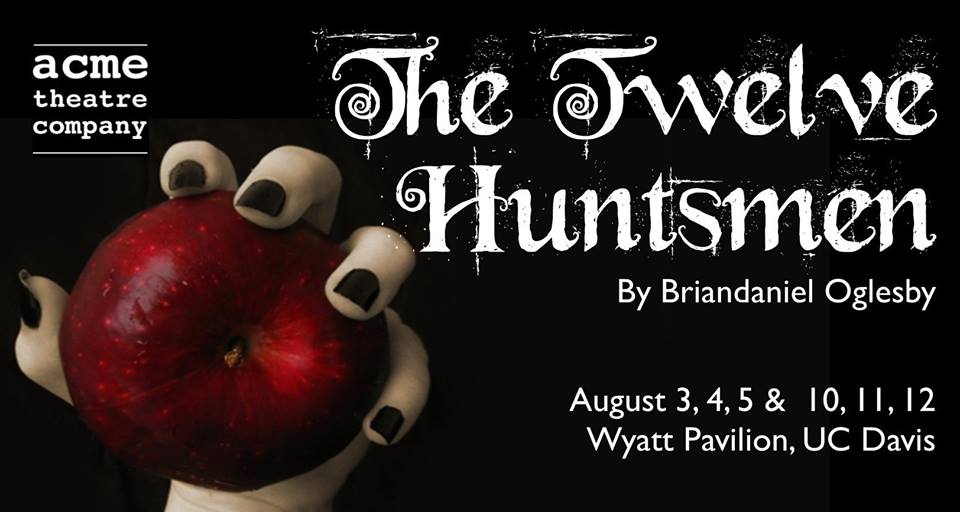
In a few days, Acme will open the world premier of THE TWELVE HUNTSMEN

Twelve Huntsmen

Like The Briars, it’s being produced in The Wyatt Pavilion Theatre.

Three years ago, Artistic Director Emily Henderson commissioned me to write an adaptation of fairy tales that had to do with food. They did not elect to produce The Twelve Huntsmen that year; I was fortunate that they hired a director this year, the fabulous Miriam Eusebio,  to whom the play appealed.

The Twelve Huntsmen is a massive undertaking. It needs at least seventeen actors, and can take on up to something like 70. We have 25 in the Acme show, and then another 10 or so doing backstage work. It’s designed so that every night can be different. While the core play of The Twelve Huntsmen is produced every night, the number and order of the rest of the plays are picked randomly.  Acme decided that they would pre-determine which plays would be performed each night (so that they could let families know if their kid would have a major role), but the order would be by chance. Even so, it’s a massive feat for the stage management, not to mention the actors who have to keep track of all their props and costumes.

I wrote the play for high schools or community theatres who want large casts. I wrote it to challenge everyone involved – to be a show that would be its own form of boot camp.

I also wanted to make a large cast play where everyone would get a substantial part with something interesting to do. The show has 25 actors, but no one disappears to become spear carrier #2.

As a side note, I want to say that, as a gay writer, I yearn to create worlds where I have a place. I often go to theatre where I have no place in the world onstage. Our Town comes to mind. In The Twelve Huntsmen, there are many kinds of love in the narratives. The current generation of Acme sports a rich diversity and includes members of the LGBTQ+ community, so they’ve chosen to represent this in the production, and I am quite pleased.

On the invisibility of LGBTQ+ Stories

I’ll have an update on B Street, Barnyard, and Acme soon, but I’m posting this separately. It bothers me.

About two months ago, someone running a website that licenses playscripts to drama teachers emailed me to say she was interested in my work. Importantly, although teachers subscribe to use the scripts at $10/month, the website does not pay the writers. Which is pretty bullshit, of course, but that debate is for another time. When I asked which plays interested her, I could have predicted the list – she wanted the ones that were adaptations of fairy tales and The Untitled Pirate Play. The glaring omission from this list was my work for young people that has overt LGBT themes – specifically, [a different] Romeo & Juliet.

On the one hand, this surprised me. The plays she asked for all share a campy, joyous aesthetic, one that the Romeo and Juliet adaptation fits squarely in the center.

On the other, there’s no surprise. Frustration, yes; but surprise, no. It’s a pretty stark, quantifiable reminder of how LGBTQ stories (especially those for young people) are edited out of the mainstream. It is how we are non-entities.

Let me be clear: young people know LGBTQ+ folks. They generally see their gay peers as normal variations in the human experience, no more deserving of censorship than left-handed people or red-heads or the lactose intolerant. Young LGBTQ+ folks are increasingly understanding, accepting, and identifying themselves. Many seek out these stories. Many want to tell the stories about people like them or their friends.

My students put forth the idea and VOTED for us to make that play.

I emailed her the following: “I will have to discuss this with my agent, but I have a few more question: How often are plays produced where the playwrights are compensated?(…)

“Finally, I must admit that I was surprised that [a different] Romeo & Juliet was not included on this list. It’s by far the most pedagogically interesting play, and one of the benefits of being a playwright who also teaches is that I get to make plays that fill a void; while there are many plays about fairy tales, I don’t think there are many LGBT stories for middle school students.”

It’s been two months and…

No response.

No surprise.

JMU and B Street

Playing catch up…

Two weeks ago I flew out to James Madison University in Virginia to work on what’s now titled Basement Demons and Trailer Saints. I’d written the play for my high school students as Bones of Saints, and I’d felt that the play was itching for more mature material. I wanted to revise it with adults, and JMU’s inaugural new play development lab accepted it for workshop. It fit.


The first few nights brought me very little sleep as I chiseled away at the script with the new actor’s voices and feedback. Pages were printed, reprinted, reprinted. I hit it with an axe, a hacksaw, a machete, a scalpel. I’ve done new play development before, but nothing that remotely approached what felt like this overhaul. Something broke through. The play is where I want it to be.

I had six fabulous actors, a good team, and a director who seemed like she was psychic. I loved this team. The play broke open…

Who could ask for anything more?

Oh, and look – more…


Next Up

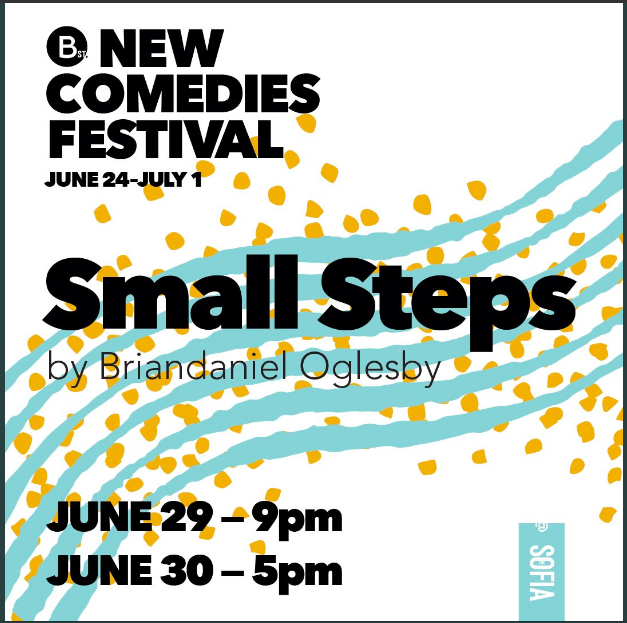
Small Steps is part of B Street Theatre’s New Comedies Festival!

Screen Shot 2018-06-20 at 3.59.26 PM.png

Tickets are available here.

And I’ve been lucky enough that The Davis Enterprise has picked up the story. 

Working with B Street has been on my bucket list.

It’s the perfect time. B Street upped their game in NNPN, and this Festival will help the new play ecosystem in Sacramento. What makes a ‘Theatre City’ – Chicago, New York, Austin, SF, Philly, LA, etc – is that each place has new work coming out of it, and a culture of support for new work. There’s something of an identity or aesthetic that emerges. There is, after all, a “Chicago play” (gritty realism / ensemble / Steppenwolf / Mamet) and an “Austin play” (Rude Mechs / devised / weird) and a “New York play” (two to four people in a single set, usually an apartment); this doesn’t necessarily mean that plays outside of the aesthetic can’t launch from those cities, as Lookingglass in Chicago with Mary Zimmerman proves, but it does demonstrate that a critical mass creates a sensibility towards an aesthetic. I wonder if this will help propel a Sacramento aesthetic? Regardless, I’m excited about the growing new play ecosystem. Onward, Sacramento!