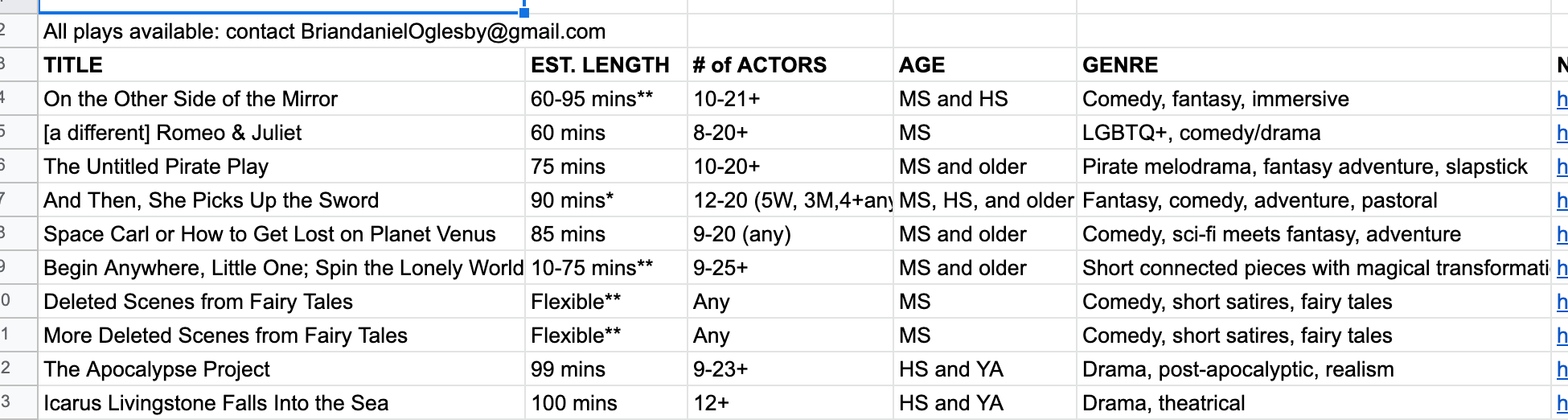
If you want a spreadsheet for easy access to my work for teens, check it out here.
official site
If you want a spreadsheet for easy access to my work for teens, check it out here.
I’ve been doing this so long, it’s getting harder to fit everything on one sheet.

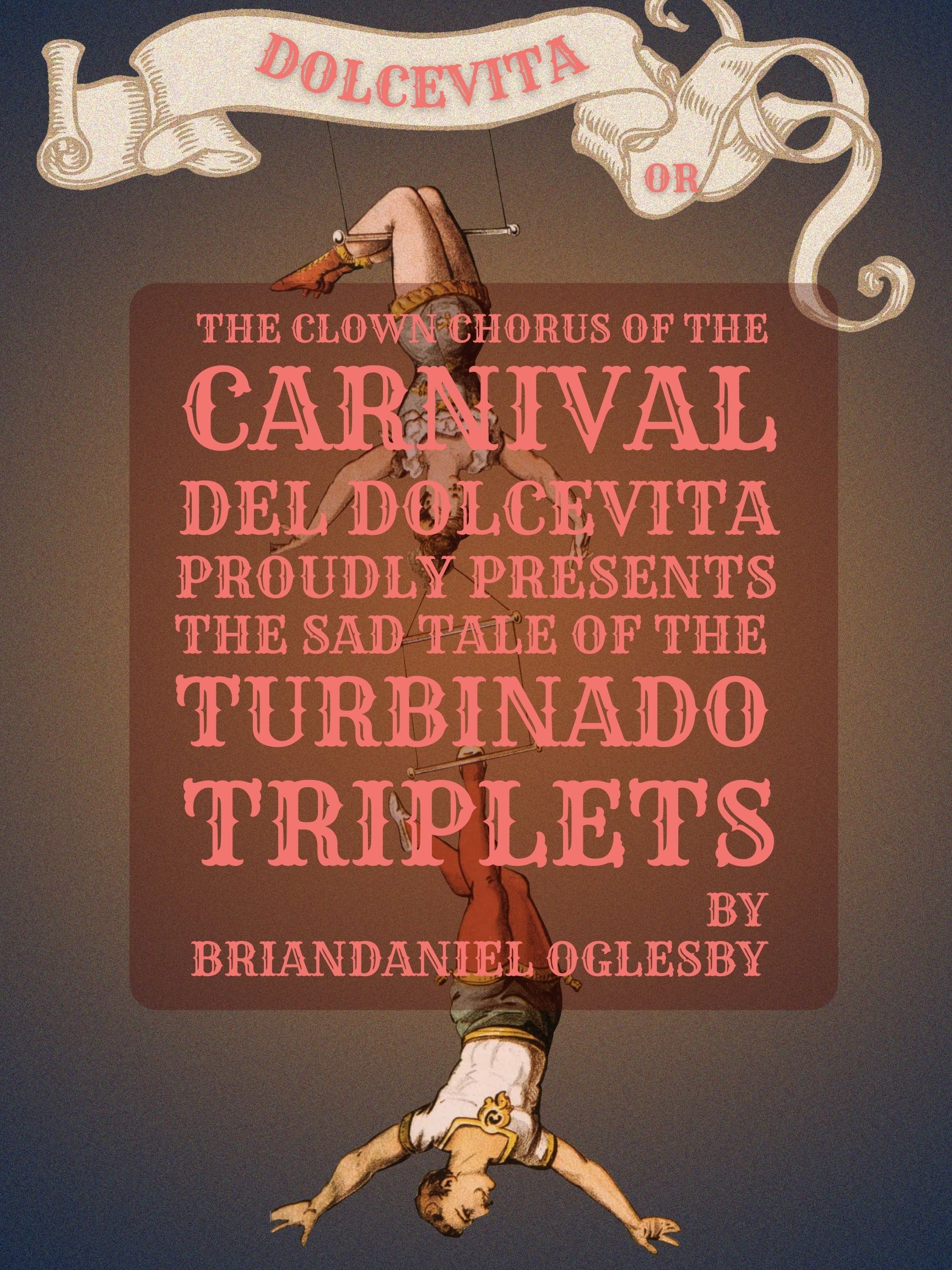
The page for DOLCEVITA or THE CLOWN CHORUS OF THE CARNIVAL DEL DOLCEVITA PROUDLY PRESENTS THE SAD TALE OF THE TURBINADO TRIPLETS is up. And you can read the current draft of the script at the New Play Exchange. As always, email me if you’d like a free perusal copy but don’t have access to NPX.
I escaped those dark woods I’d previously mentioned, and wrote the artsy middle school play.
It was all-consuming. It’s bonkers. A tragicomic circus carnival of a play.
I had a magical team. Nearly all of my middle school collaborators had worked on multiple plays with me, and I wanted to make something that would match their skills. Hence a challenge: How do you make a play with the weight of a play for mature audiences but for 6-8th graders?
I’ll be posting about the process, which began as a sort of game of theatrical telephone with the designers. We invented theatre games and took creative risks. And that presented another struggle how do you include, honor, and add to these theatrical experiments? “Kill your darlings!” is an old phrase, but these weren’t always mine to kill
I’ll also post about the play itself, which I wanted to feel like a novel – or four.
All this will take me some time.
Stage Partners has now published THE TWELVE HUNTSMEN!
Seven years ago, Acme Theatre commissioned me to write a play based on fairy tales and food. Why fairy tales? We wanted to remodel old stories to fit with the living community. Why food? Food is complicated, often a cultural signifier – and more.
(Also, Acme Theatre is based in my hometown, which is surrounded by ag fields. My grandparents were farmworkers so I am conscious I wouldn’t exist without those fields, which I think about when I’m in California. While this idea is entirely invisible in The Twelve Huntsmen, it was a frequent topic of conversation with Emily, the AD who commissioned me.)
But, okay, fairy tales. The very nature of fairy tales is that they are told from generation to generation, so it’s ground that many, many have tread (trod?). What is my take on these?
And, I wanted to make something that would be an experience for the actors and the audience. I wanted something that would be memorable, that would be different. That would challenge them.
And then, as I read hundreds of Grimms’ stories, I found The Twelve Huntsmen. A princess gets eleven women to dress as men so she can get closer to the prince. Proto-feminist. Drag. Woodsy. It’s everything I want in a fairy tale.
Look, y’all. It’s a lightweight story, which is probably why so few have done anything with it. It reads almost like it’s the summary of a longer story that someone misplaced. This is why it’s not as well-known, I think, as Hansel and Gretel or Snow White.
Twelve women. What a random number, I thought. And the commission, it’s to transform many stories into a play… what if each woman has a story?
Okay, I love that. What makes this different from something Mary Zimmerman has written?
Well, what if every night is different? What if the stories are random? What if not every story is told every night?
I wanted to make a play that would be as challenging to produce as a musical, that would need an incredible stage manager to pull off, that needed improv and innovation, that people would see multiple times and get something different every night, and that could only ever be a play.
And thus, The Twelve Huntsmen. A play that can be done hundreds of thousands of ways.
And now Stage Partners has published it.
One thing that I like about Stage Partners is that they provide free perusals of scripts online. I don’t knock any particular business model (well, except for that one publisher that wanted all of my non-LGBTQ+ work) ’cause we all gotta eat, but I do believe that it’s in everyone’s interest to provide perusal scripts from free. The reason that Big Idea Theatre commissioned me to write an adaptation of The Jungle Book was because they couldn’t find a decent adaptation from other publishers, and it must have been obnoxious for them to spend a significant amount of their budget buying the lazy versions out there. Beyond that, consider this: for many schools, the educational theatre budget is pretty small, and if they don’t have money to spend on play scripts, they are going to save money and rely on plays the teacher has seen or plays that are low risk – i.e. well-known playwrights. If you can read the script, you’re not relying on the brand of the publisher or the brand of the playwright or the cute cover – you’re able to decide if you want to produce the play based on the script itself.
And I want people to read The Twelve Huntsmen.
I believe theatre for teens can be art…
The consequences of this belief is that it’s really f*****’ hard to write this play. I am lost in these dark woods.
Been there before. Been there so many times, I know it’s the right metaphor.
I’ll drop a long post sometime when I can see light. As it is, wish me luck.
Oh come all ye faithful /
Joyful and, like, triumphant….
Or something?
I’ve done my post show revisions to Forever Christmastown, and it’s up on the New Play Exchange. Check it out. Read/review/produce it.
The page is here.
Forever Christmastown started with a few days of improv, a reading from Noises Off, some dusty decorations I took down from the shelf, and a loose concept, and it became a beautiful, tinsel-eating monster of a play. Act I is fairly traditional as the crew attempts to put on a show to save Forever Christmastown, whereas Act II goes off the rails when they accidentally start a cult. This is shortly followed by them declaring the theme park a sovereign nation. It’s very Texas. And it’s very me.
In the end, while a few of the characters do have full arcs, there’s only one character who truly changes. Everyone else doubles down. Although a big reveal waves away some of the negativity, I wondered if the cynical elements that live beneath this comedy would make this too dark, and would impact our experience or the message to our audience. Instead, we found that it was joy to produce and perform. The play finds common ground between people who are jaded by commercial Christmas and people who love the holiday season. I drink black coffee, but this play is also for our Pumpkin Spice Latte-drinking friends.

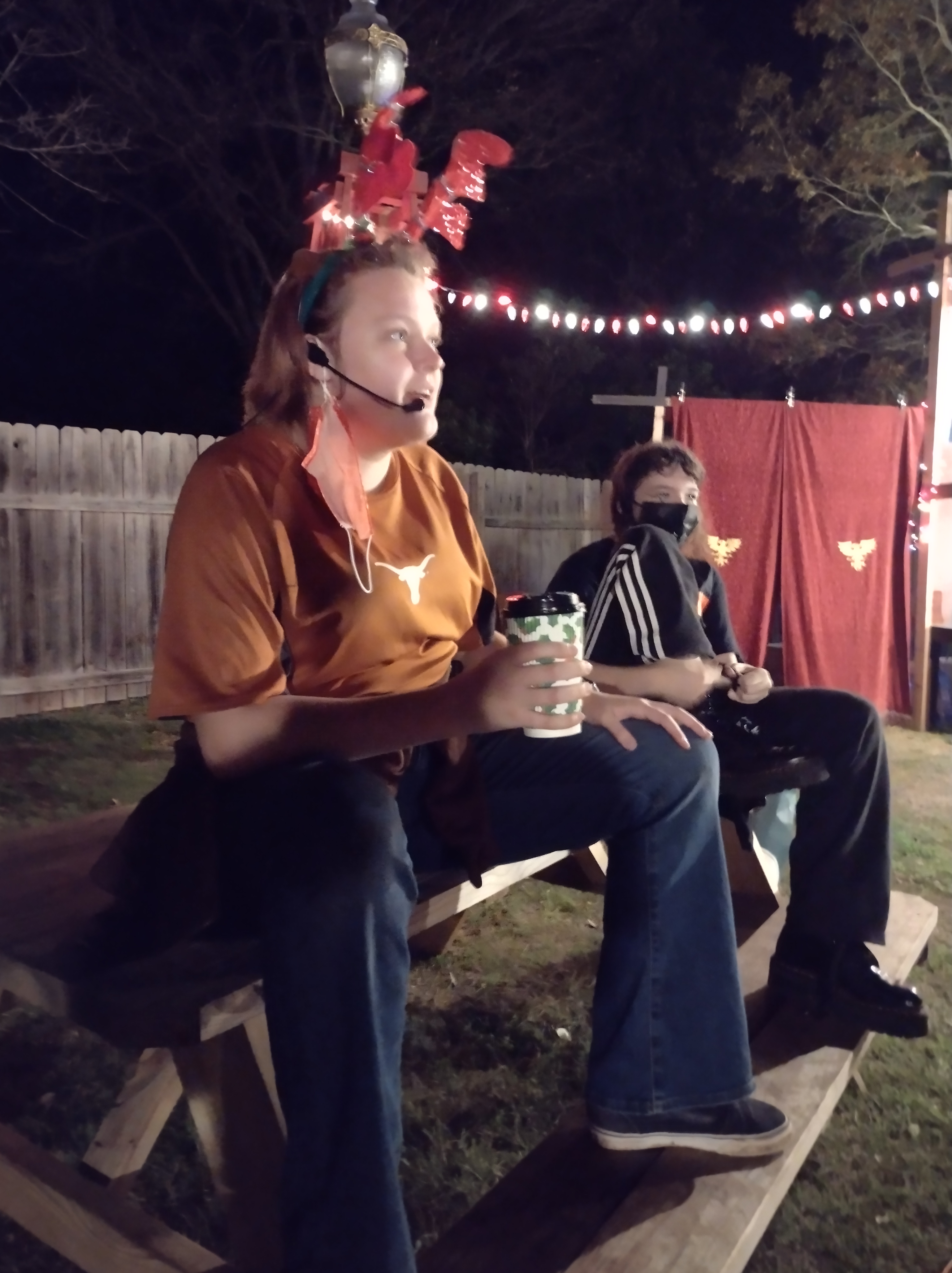
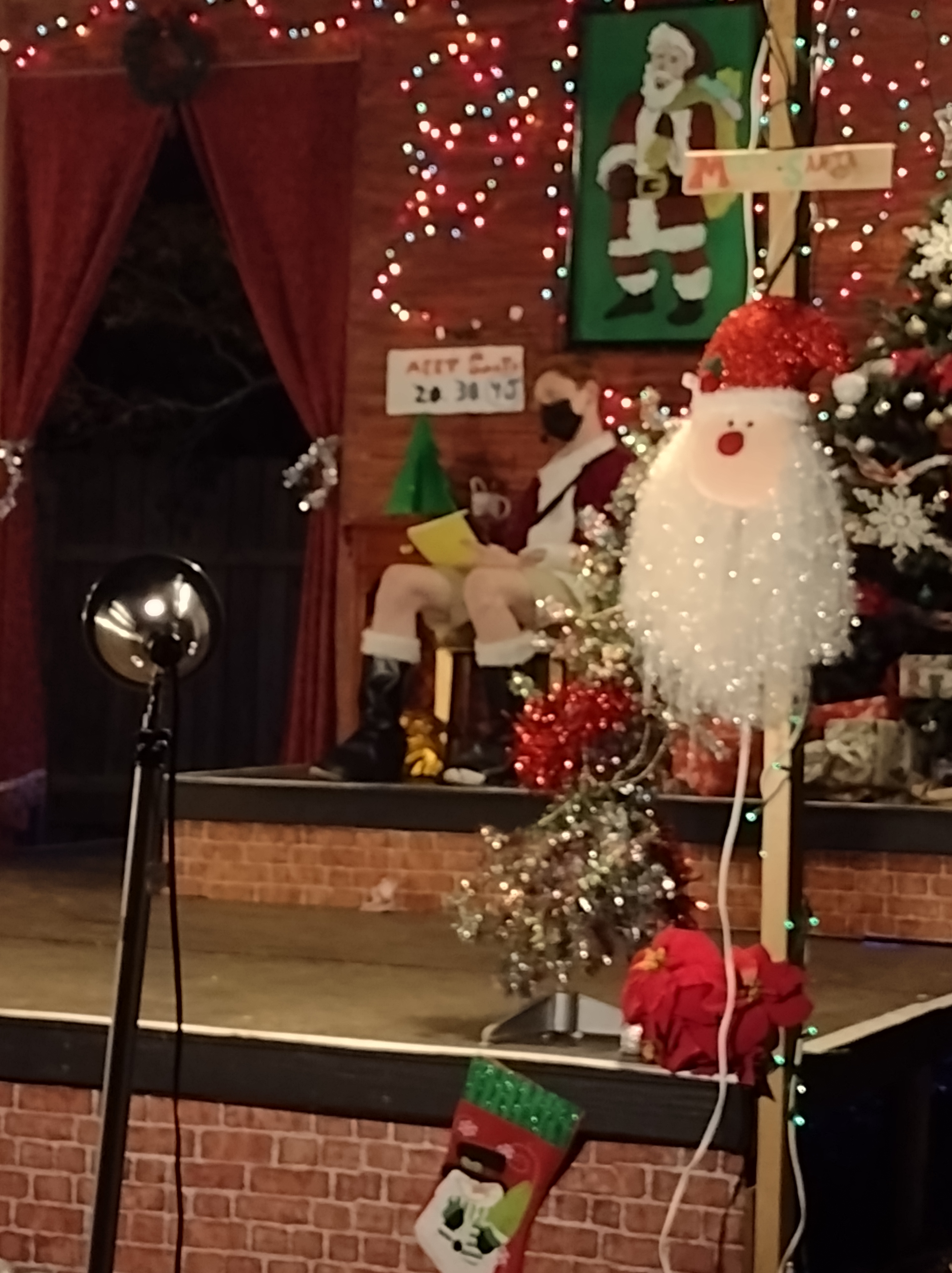


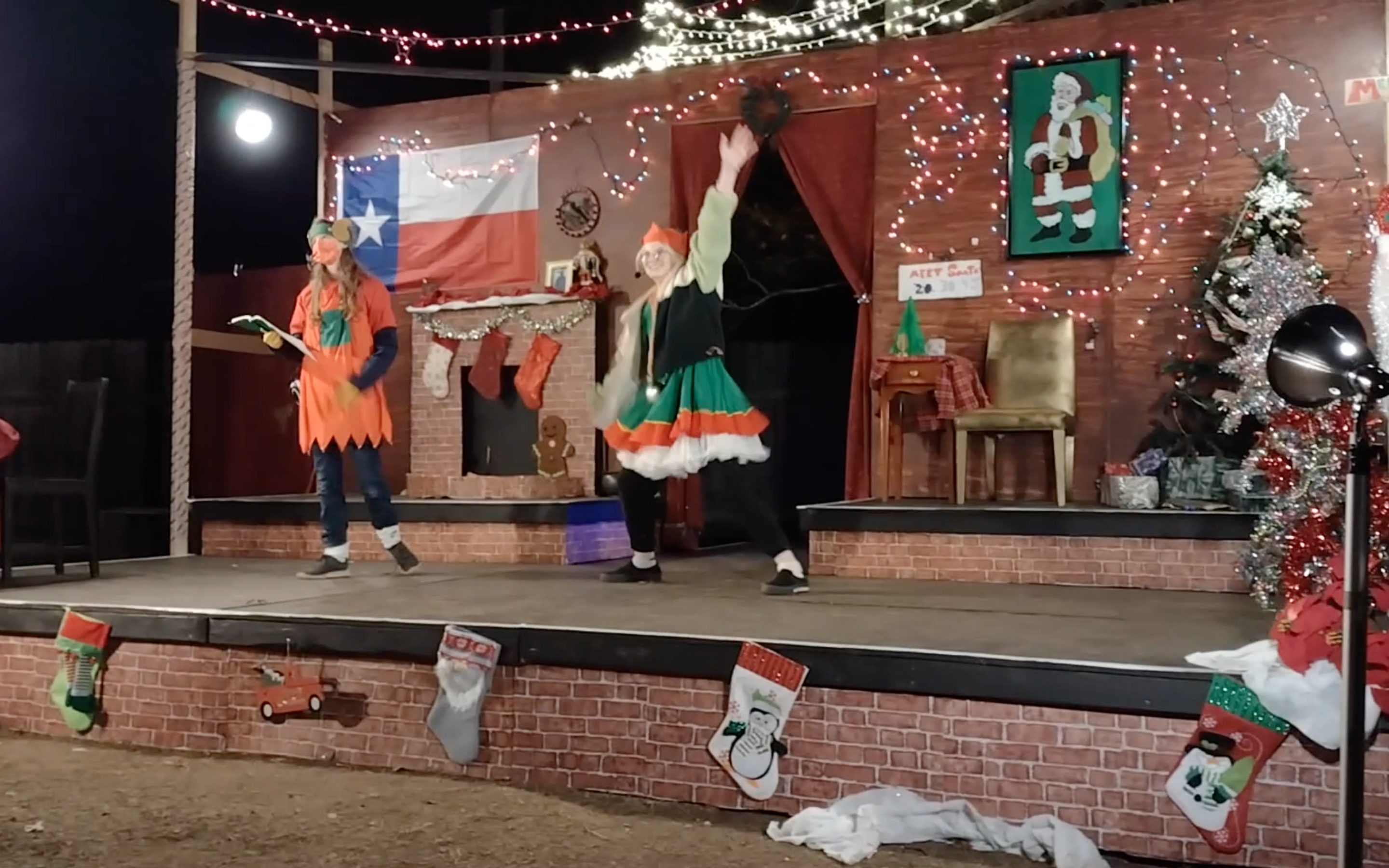
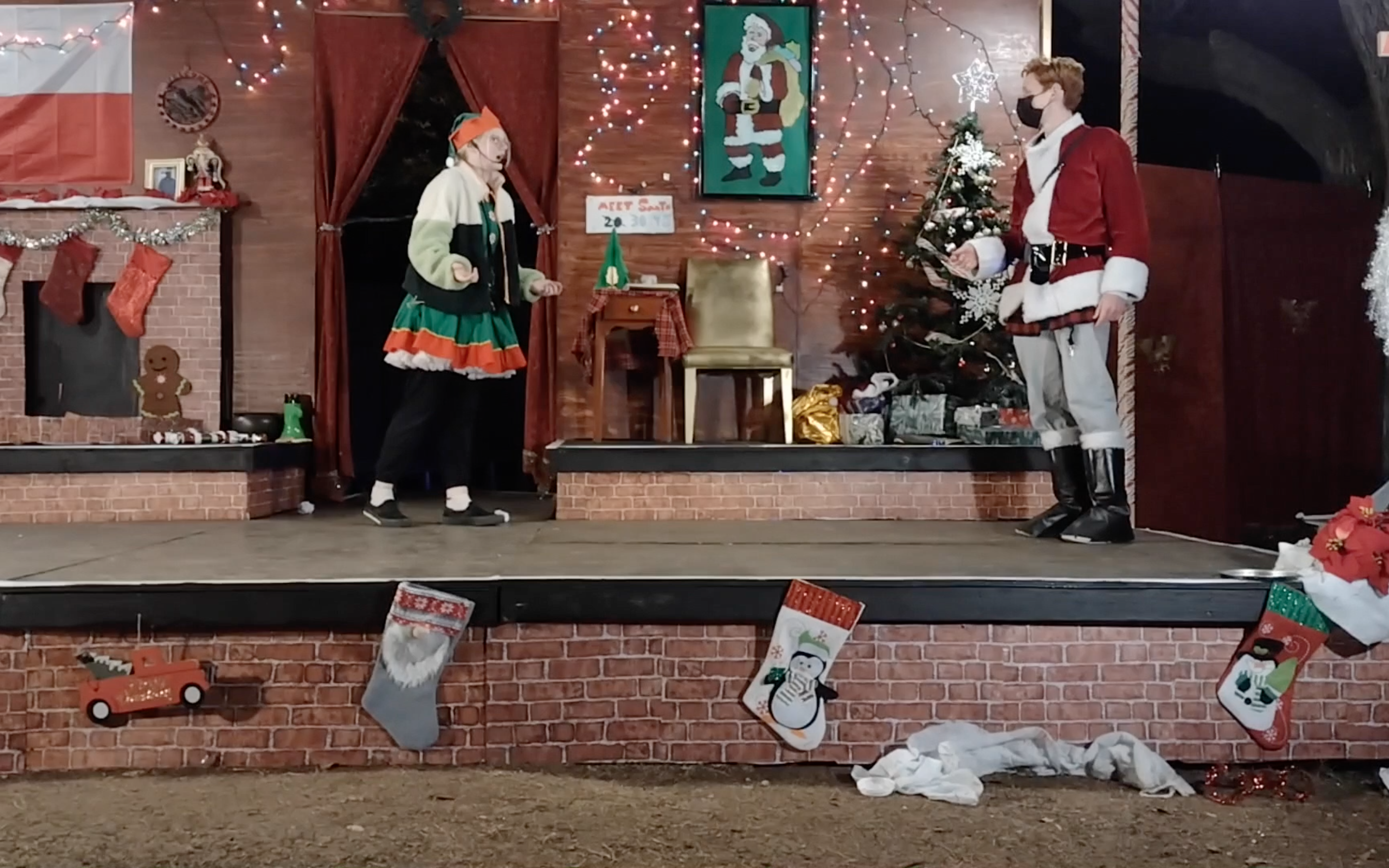


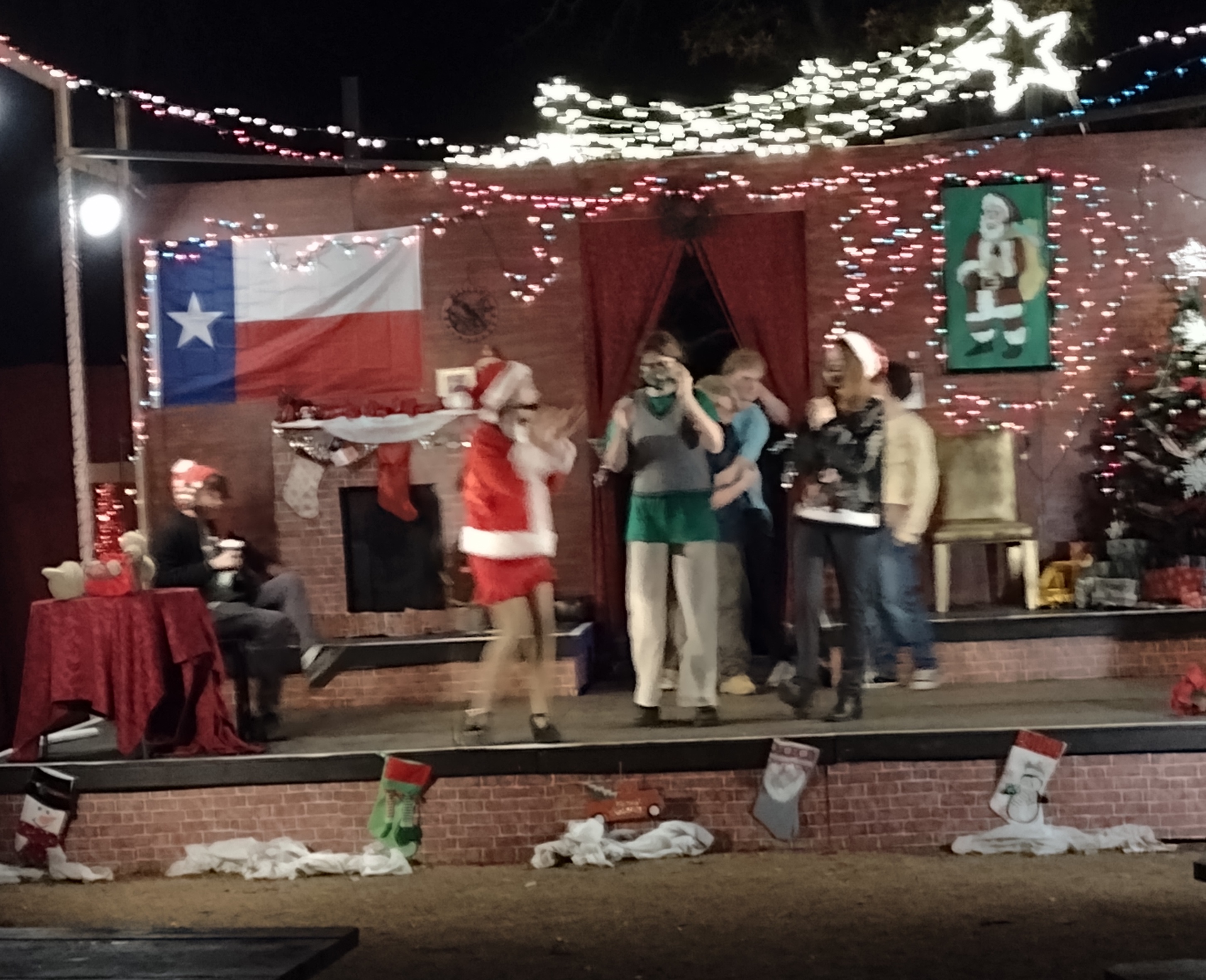
I’ll post again once I’ve gotten pictures and have done my post-show revision of Forever Christmastown, my newest play.
Before I get into the summary, I want to take a moment to honor Bill Jacox. Bill was my boss when I was in undergrad, when I tried my hand at team building on a ropes’ course at UC Irvine. The funny thing is that, although what we did often involved dangling from a climbing harness 30 feet in the air, I owe him more of my pedagogy and dramaturgy than he ever knew. He died recently.
I mention him because one of the many things I learned from him was how to productively reflect: Pros, Lows, and Grows. The things that worked, the things that didn’t work, how to get better. Thank you, Bill.
PROS
LOWS
GROWS

One of my students asked for help with finding comedic monologues. I pulled a number of these for him and put them into a document.
One of those projects I always intend but never do is to compile a collection of monologues for young actors. I always think, oh, I should annotate the context for each one. I should break them down by gender, theme, genre. And then another project gets in the way.
But then I had my student D seek monologues for acting classes and auditions.
Here is the compilation, though I admit that it’s incomplete and disorganized, as it was constructed mostly for D. Email me or check out the New Play Exchange for any of the full scripts if you need it.
Here’s the pitch: Claire is an unpaid intern at the Forever Christmastown, a holiday-based theme park in the style of a ren faire in rural Bastrop County, Texas. She’s excited for this job because she’s been told her entire life that Santa is her father. Unfortunately, the Forever Christmastown is known more for problems with wild boars and accidents, and while an Alamo-inspired play seems to be the key to bringing audience members to the park, it’s a viral miracle that brings forth a Santa-worshipping, uh, cult-like group of followers. Pretty soon, things spin out of control.
Currently, characters include Chewy the Elf, Santa Tyler, Mrs. Claus, Crispy the Snowman, Comet and Blitzen, and Santacolytes. Future drafts will add a bit more to the population.
PROCESS LESSONS
Now, one thing making theatre from scratch with a group of teenagers teaches you is how to avoid the sunk-cost fallacy. I spent the first couple weeks devising around a different play, and I had to pivot when the words on the page felt dead, and I think about how the temptation would have been to keep throwing energy at a project that was falling apart. Deadlines have a way of doing that, particularly when the stakes are high, at least artistically.
If you’re reading this blog for advice on creating work with young actors, then please take that – one of the keys to making thing happen is to be conscious of the sunk-cost fallacy, be wary of it, and find ways to test yourself. I have my own tricks when I need to figure out if I’m putting money into a lemon – find out what works for you.
OTHER CELEBRATIONS
I have a handful of productions going up in various corners of the country, and it’s truly delightful. Even as we’re delaying Small Steps, the work for young people finds homes. Last week, I had a conversation with a director producing The Apocalypse Project whose students had a handful of suggestions for ways to edit and evolve the text. When I was younger and more insecure, I don’t think my ego could have handled that, but I’d asked for their thoughts. Some edits are specific to the group, some will wind up canon, and others I pushed back on, but it felt exciting to collaborate from such distances.
Best, y’all,
B
 Briandaniel Oglesby